At a glance
What this guide can help you understand
Understand how work habits, structural conditions, and acquired changes can affect posture in adulthood—and what assessment and physiotherapy can reasonably address in Gurugram.
What should you bring to a consultation?
Share your main concern, when it started, what affects it, current medicines, and any reports or precautions you have been given.
See our clinical assessment approachWhen should you pause and seek medical advice?
Pause routine exercise and seek medical advice for sudden severe change, new neurological symptoms, breathing difficulty, chest pain, major injury, or feeling acutely unwell.
This guide is educational and does not replace diagnosis or urgent care.
People often use “posture” to describe how they sit, stand, or hold their shoulders, but there is no single position every adult must maintain all day. Bodies vary, and a visible difference does not by itself explain pain or prove that a person is moving incorrectly. A posture concern may relate to a flexible work habit, a developmental or structural spinal condition, an injury, or another health change. Assessment starts with the person's function and history, not with a promise to straighten the body.
The practical context in this city
In Gurugram, an individual may want to manage desk work, meetings, travel, home responsibilities, or a return to exercise. These are possible task contexts, not assumptions about all residents or evidence that the city causes posture problems. A useful plan asks which position or task is difficult, how long it is tolerated, and what the person wants to do with more comfort or confidence. A workstation adjustment may be relevant for one person; another may need medical assessment before exercise advice is appropriate. The city name helps readers find the guide; it is not a diagnosis or a claim about local prevalence.
What a physiotherapist assesses
A physiotherapist asks when the concern began, whether it is changing, what activities are limited, and whether there was an injury, operation, illness, or known spinal condition. The assessment may include comfortable range of movement, strength and endurance, walking and balance, task tolerance, and how symptoms respond when a position or task is varied. Work setup can be reviewed without searching for one ideal chair or forcing the spine into a rigid shape. The clinician also asks about rest or night pain, fever, unexplained weight loss, numbness, weakness, bladder or bowel changes, and relevant medical history. A physiotherapist can identify when findings need a medical opinion, but visual inspection alone does not diagnose scoliosis, arthritis, nerve disease, or another structural cause. New or progressive asymmetry deserves medical review. The person's own goal—such as sitting through a meeting, looking over a shoulder, carrying a bag, or returning to a hobby—helps determine which changes matter.
How rehabilitation can progress
Occupational or flexible movement habits
When a pattern is changeable and symptoms are linked to a task, the goal may be to reduce prolonged awkward positions, vary the task, adjust the work surface or screen, and build strength or endurance for the day the person actually has. A physiotherapist may practise comfortable reaching, lifting, or sitting transitions and help the person test one adjustment at a time. “Correction” in this setting can mean finding a workable position or changing a habit that is contributing to strain; it does not mean holding a rigid posture without movement. Health and safety guidance focuses on reducing awkward exposure and making tasks manageable, not on maintaining one perfect alignment. Short movement breaks, a screen position that avoids repeated end-range turning, or a change in task order can be more practical than buying a brace or attempting to sit bolt upright for hours.
Developmental or structural changes
Some adults have a spinal curve or other structural difference that began during growth or relates to a medical condition. A fixed bone shape is not the same as a flexible position that changes with movement, and exercise cannot be promised to reverse a structural curve. The medical team decides whether imaging, specialist review, monitoring, or another treatment is needed. Physiotherapy may still support strength, mobility, balance, confidence, and daily function within the person's clinical plan. A new or visibly progressing curve, especially with pain or neurological changes, should be assessed rather than treated as a simple desk habit. A treatment goal might be easier breathing during activity, comfortable reaching, or improved walking tolerance; it should not be framed as guaranteeing a straighter spine.
Other acquired changes
Injury, surgery, degenerative joint or spinal disease, inflammatory conditions, and neurological conditions can alter movement or alignment. These causes need different assessment and may require coordination with a doctor or specialist. Rehabilitation can address a defined functional goal, such as tolerating a workday, reaching overhead, walking, or lifting a light household object, while respecting medical precautions. Progress is reviewed by comfort, capacity, and task performance—not by a promise that a body shape will change. If a plan increases symptoms or reveals new weakness or sensory change, pause the activity and contact the appropriate clinician. The right response may be a change to the work task, a graded exercise plan, medical investigation, or a combination; a generic “posture correction” routine cannot choose that pathway.
What to expect from a home physiotherapy session
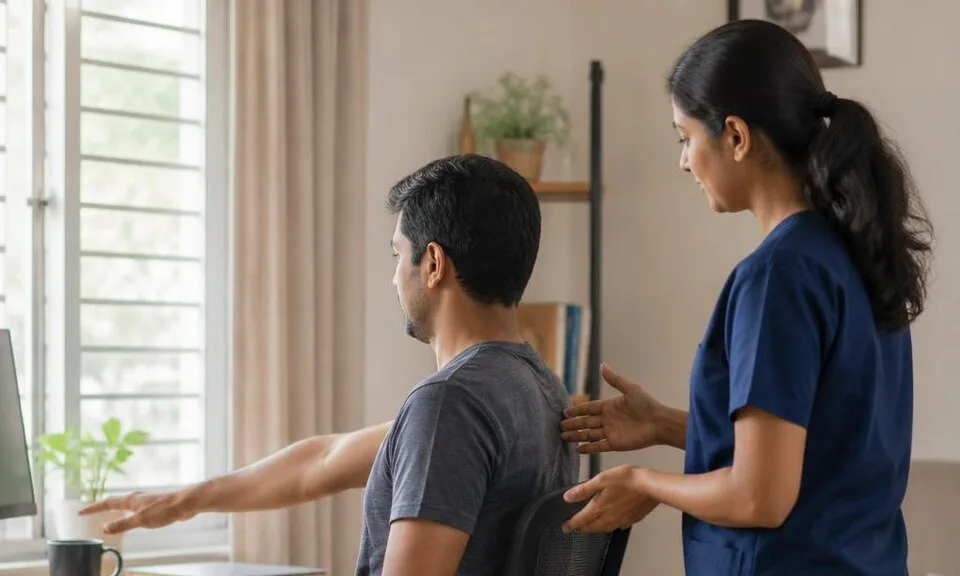
A home session can make assessment practical by looking at the actual desk, chair, screen position, usual work objects, and the movement the person finds difficult. With consent, the physiotherapist observes a comfortable task and may suggest a small change in reach, break timing, or movement variation. A strengthening or mobility plan is chosen only when it fits the person's symptoms and medical history. The session should not use forceful hands-on positioning to “put the spine back,” and it should not discourage a medical review when the history or examination calls for one. The person and therapist agree how to judge progress in daily function and when to check back. A family member or colleague can join a discussion if the person wants help putting a work change into practice, but the plan remains individual.
Do
- Notice which tasks bring on symptoms, vary positions before discomfort becomes difficult to settle, keep a workstation adjustment comfortable rather than rigid, and build prescribed strength or movement gradually while tracking function.
- Keep a simple record of symptoms, activity, sleep, and the tasks that are becoming easier or harder.
- Share medical reports, medication changes, surgeon restrictions, and any recent change in symptoms before exercise is progressed.
Don’t
- Do not blame all pain on posture, buy a brace or device to force a “perfect” position without advice, or assume that stretching can reverse a structural curve. Do not ignore a new or progressive change just because it is painless or appears to be a work habit.
- Do not copy an exercise from a video if it increases symptoms, requires equipment you cannot control, or conflicts with a medical restriction.
- Do not use pain, fatigue, or a single good day as the only measure of readiness for a harder task.
Safety and when to seek medical advice
Arrange medical review for a new or progressive spinal curve, persistent pain at rest or at night, symptoms after significant trauma, or pain with fever or unexplained weight loss. Any of these symptoms—new leg weakness, numbness around the saddle area, loss of bladder or bowel control, or inability to pass urine—requires urgent medical assessment. Seek urgent care rather than waiting for a routine physiotherapy appointment when neurological function changes suddenly. Seek prompt medical attention for a rapidly worsening change, a recent major injury, or a new loss of walking or hand function. This guide cannot determine the cause of a posture difference or decide whether imaging or specialist care is required.
Booking and follow-up
Goswami Rehab offers home visits at ₹1,125 – ₹1,350 and online consultation at ₹742. Send the online booking request with the main concern, city, and preferred dates; the team confirms the appropriate next step within 24 hours. A teleconsultation can be useful when travel is difficult or when an exercise plan needs review, but it does not replace emergency or specialist medical care.
Local coverage: Home physiotherapy in Gurugram (Gurgaon).
Clinical sources & further reading
These public resources provide general clinical guidance. They do not replace an assessment or an individual treatment plan.
- Posture ReframedSouth Tees Hospitals NHS Foundation Trust
- ScoliosisNHS
- Reducing awkward posturesHealth and Safety Executive
- Effects of stretching or strengthening exercise on spinal and lumbopelvic posture: a systematic review with meta-analysisJournal of Bodywork and Movement Therapies
- Low back pain and sciatica in over 16s: assessment and management (NG59)National Institute for Health and Care Excellence
- Gurugram District: official district informationDistrict Administration, Gurugram
- Orthopedic conditionsNational Institute of Arthritis and Musculoskeletal and Skin Diseases
Continue exploring
Choose your next step
Keep exploring with a focused guide, a relevant care option, or a direct enquiry.
Need professional advice?
Book an assessment with our expert team.