At a glance
What this guide can help you understand
What a vestibular physiotherapy assessment may include, how balance exercises are progressed, and which dizziness symptoms need medical review in Gurugram.
What should you bring to a consultation?
Share your main concern, when it started, what affects it, current medicines, and any reports or precautions you have been given.
See our clinical assessment approachWhen should you pause and seek medical advice?
Pause routine exercise and seek medical advice for sudden severe change, new neurological symptoms, breathing difficulty, chest pain, major injury, or feeling acutely unwell.
This guide is educational and does not replace diagnosis or urgent care.
Dizziness can feel like spinning, floating, light-headedness, visual instability, or unsteadiness. Vestibular rehabilitation is not a single exercise for every symptom. The first task is to understand the timing, triggers, hearing symptoms, neurological features, medication context, and the person’s risk of falling.
The practical context in this city
A home assessment can be relevant in Gurugram when a person is afraid to travel, when visual movement and busy corridors increase symptoms, or when the main goal is to move safely around an apartment. The therapist uses the home environment carefully; exercises are selected only after screening suggests they are appropriate, and the person is told what response is expected.
What a physiotherapist assesses
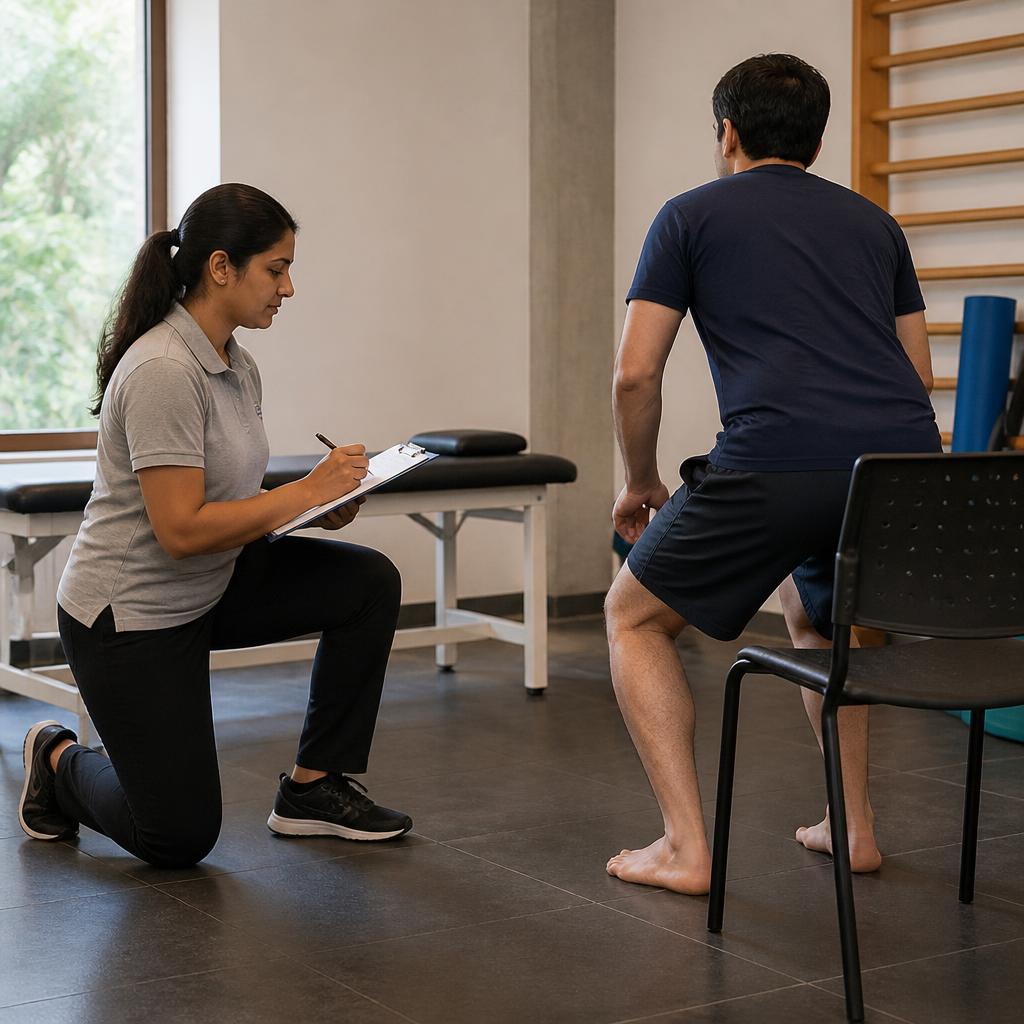
The physiotherapist asks whether symptoms are triggered by rolling in bed, looking up, walking, screens, or standing. Eye movements, head movement, gait, balance, cervical contribution, blood-pressure symptoms, and hearing or migraine history may be considered. Some positional vertigo patterns require a specific manoeuvre; others need medical or ear, nose, and throat assessment before treatment.
How rehabilitation can progress
For vestibular hypofunction, a plan may progress from controlled gaze-stability practice to head movement while standing and then walking with visual challenges. Balance work is adapted to the person’s fall risk. Mild, brief symptom provocation can be part of a programme, but severe or prolonged worsening is a reason to stop and contact the treating professional.
What to expect from a home physiotherapy session
The therapist creates a clear, uncluttered practice space and checks how the person moves from bed to standing. They may observe a positional transition, teach a gaze exercise, and practise turning or walking with a support nearby. The home plan includes dose, speed, symptom limits, and what to do if the expected response does not occur.
Do
- Move at the prescribed speed, use a stable support during early balance practice, keep lighting consistent, and record the trigger, duration, and recovery time of each episode.
- Keep a simple record of symptoms, activity, sleep, and the tasks that are becoming easier or harder.
- Share medical reports, medication changes, surgeon restrictions, and any recent change in symptoms before exercise is progressed.
Don’t
- Do not label every dizzy spell as an inner-ear problem, practise challenging balance exercises beside a staircase, or drive when symptoms make visual tracking or reaction unsafe.
- Do not copy an exercise from a video if it increases symptoms, requires equipment you cannot control, or conflicts with a medical restriction.
- Do not use pain, fatigue, or a single good day as the only measure of readiness for a harder task.
Safety and when to seek medical advice
Any of these symptoms—sudden severe dizziness with new weakness, facial droop, speech difficulty, double vision, severe headache, fainting, chest pain, new hearing loss, or inability to walk—needs urgent medical assessment. Any of these symptoms—repeated vomiting, fever, or a new severe symptom pattern—requires medical advice.
Booking and follow-up
Home physiotherapy is arranged after the team understands the person’s condition, location, current precautions, and preferred care. Goswami Rehab offers home visits at ₹1,125–₹1,350 and online consultation at ₹742. Send the online booking request with the main concern, city, and preferred dates; the team confirms the appropriate next step within 24 hours. A teleconsultation can be useful when travel is difficult or when an exercise plan needs review, but it does not replace emergency or specialist medical care.
The article is educational information only. It does not diagnose a condition or replace advice from a doctor, surgeon, obstetrician, cancer team, or treating physiotherapist. Individual plans, timelines, and outcomes vary.
Clinical sources & further reading
These public resources provide general clinical guidance. They do not replace an assessment or an individual treatment plan.
Continue exploring
Choose your next step
Keep exploring with a focused guide, a relevant care option, or a direct enquiry.
Need professional advice?
Book an assessment with our expert team.