At a glance
What this guide can help you understand
A practical physiotherapy guide to shoulder and elbow capacity, repeated craft positions, micro-breaks, and graded strengthening in Moradabad.
What should you bring to a consultation?
Share your main concern, when it started, what affects it, current medicines, and any reports or precautions you have been given.
See our clinical assessment approachWhen should you pause and seek medical advice?
Pause routine exercise and seek medical advice for sudden severe change, new neurological symptoms, breathing difficulty, chest pain, major injury, or feeling acutely unwell.
This guide is educational and does not replace diagnosis or urgent care.
Shoulder or elbow pain during craft work can arise from repeated reaching, static positions, gripping, vibration, a recent injury, or a problem outside the arm. The treatment depends on the examination and the work demand. The aim is to restore useful capacity while avoiding a sudden jump from rest to a full workload.
The practical context in this city
Craft work in Moradabad may require close visual attention, a supported or elevated arm, tool control, and repeated small movements. A home programme is more useful when it explains how to change the height, support, grip, sequence, or pause pattern of the real task. These are possible load factors, not a claim about every workshop.
What a physiotherapist assesses
The therapist asks which position brings symptoms on, whether pain travels below the elbow, and whether there is weakness, night pain, swelling, or loss of movement. They assess shoulder range, scapular control, neck and nerve contribution, elbow and wrist loading, grip, and a light version of the work posture. Trauma, fever, deformity, or rapidly progressive weakness needs another pathway.
How rehabilitation can progress
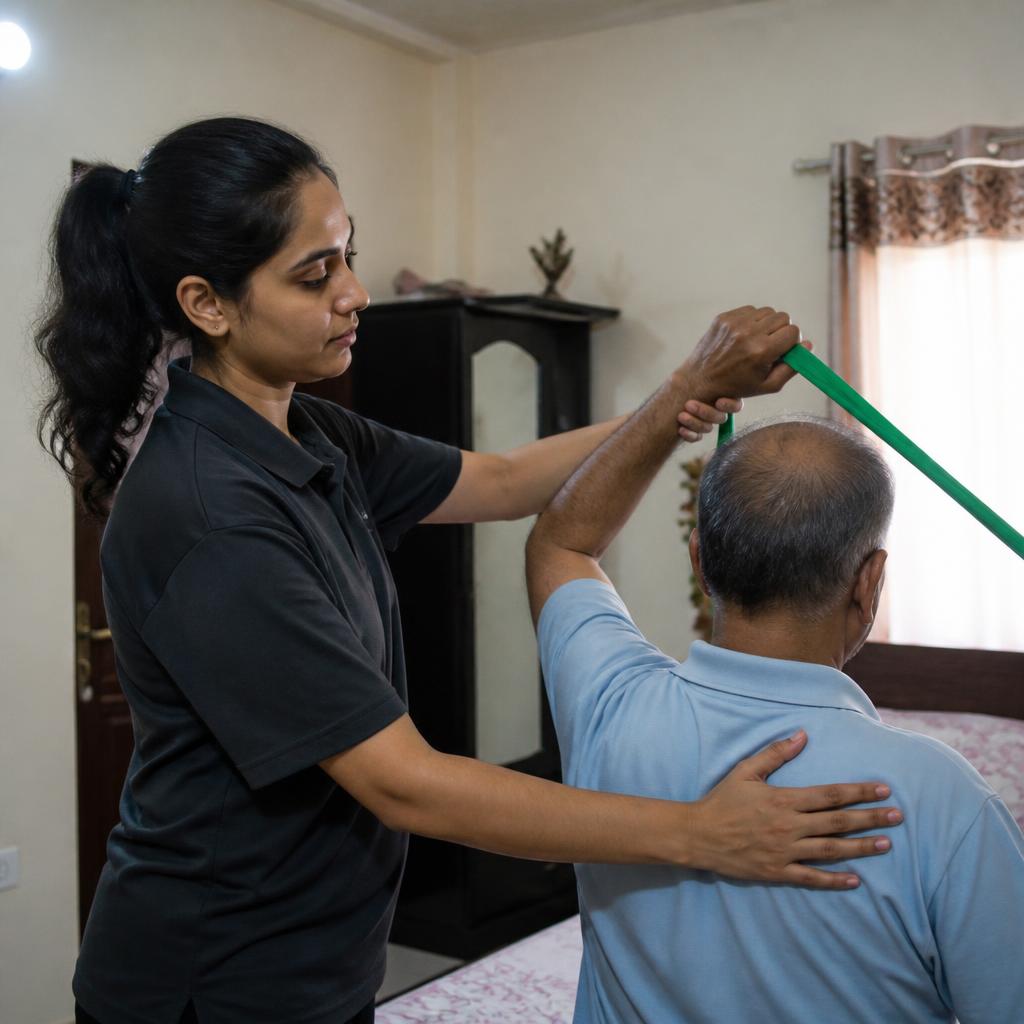
Early management may reduce the most provocative position while maintaining comfortable movement. Strengthening can progress from supported shoulder and forearm work to reaching, carrying, and sustained precision. Work exposure is increased by time, force, arm elevation, and repetition one variable at a time, with micro-breaks planned before fatigue causes loss of control.
What to expect from a home physiotherapy session
The therapist reviews the work surface or a safe imitation, then teaches a few movements that address range, shoulder blade control, and forearm capacity. They may help the person plan task rotation and a short recovery routine. At follow-up, the important measures are function, next-day response, and the ability to complete a safer work block.
Do
- Change the arm position when possible, support the forearm for precision tasks, rotate demanding activities, and build shoulder and forearm strength with the prescribed tempo.
- Keep a simple record of symptoms, activity, sleep, and the tasks that are becoming easier or harder.
- Share medical reports, medication changes, surgeon restrictions, and any recent change in symptoms before exercise is progressed.
Don’t
- Do not repeatedly test a painful overhead position, rest the arm completely for long periods without a graded plan, or assume a brace fixes the load created by a long work block.
- Do not copy an exercise from a video if it increases symptoms, requires equipment you cannot control, or conflicts with a medical restriction.
- Do not use pain, fatigue, or a single good day as the only measure of readiness for a harder task.
Safety and when to seek medical advice
Urgent medical assessment is needed after a major injury, deformity, sudden weakness, fever, hot swollen joint, chest symptoms, or new numbness that is progressing. Persistent night pain or unexplained loss of movement warrants review.
Booking and follow-up
Home physiotherapy is arranged after the team understands the person’s condition, location, current precautions, and preferred care. Goswami Rehab offers home visits at ₹1,125–₹1,350 and online consultation at ₹742. Send the online booking request with the main concern, city, and preferred dates; the team confirms the appropriate next step within 24 hours. A teleconsultation can be useful when travel is difficult or when an exercise plan needs review, but it does not replace emergency or specialist medical care.
The article is educational information only. It does not diagnose a condition or replace advice from a doctor, surgeon, obstetrician, cancer team, or treating physiotherapist. Individual plans, timelines, and outcomes vary.
Clinical sources & further reading
These public resources provide general clinical guidance. They do not replace an assessment or an individual treatment plan.
- Musculoskeletal disorders at workHealth and Safety Executive
- PhysiotherapyNHS
- Tennis elbowNHS
- Moradabad District: official district informationDistrict Administration, Moradabad
- RehabilitationMedlinePlus, U.S. National Library of Medicine
- Orthopedic conditionsNational Institute of Arthritis and Musculoskeletal and Skin Diseases
Continue exploring
Choose your next step
Keep exploring with a focused guide, a relevant care option, or a direct enquiry.
Need professional advice?
Book an assessment with our expert team.