At a glance
What this guide can help you understand
How Amritsar families can practise useful walking and attention tasks after neurological illness without adding unsafe distractions.
What should you bring to a consultation?
Share your main concern, when it started, what affects it, current medicines, and any reports or precautions you have been given.
See our clinical assessment approachWhen should you pause and seek medical advice?
Pause routine exercise and seek medical advice for sudden severe change, new neurological symptoms, breathing difficulty, chest pain, major injury, or feeling acutely unwell.
This guide is educational and does not replace diagnosis or urgent care.
Walking may look safe in a quiet room and become less reliable when a person turns, carries a cup, talks, searches for a phone, or responds to a family member. This is a dual-task question: the challenge is not simply balance, and it is not a reason to add distractions without assessment. Physiotherapy can identify which everyday task is safe to practise and when attention should return fully to walking.
The practical context in this city
Amritsar is the practical setting for this home assessment, not a claim about local falls or neurological outcomes. The route may include a bed, bathroom, courtyard, doorway, or a familiar short walk. Age, stroke or other neurological illness, vision, hearing, medication effects, confidence, and the home surface all influence whether a second task is appropriate.
What a physiotherapist assesses
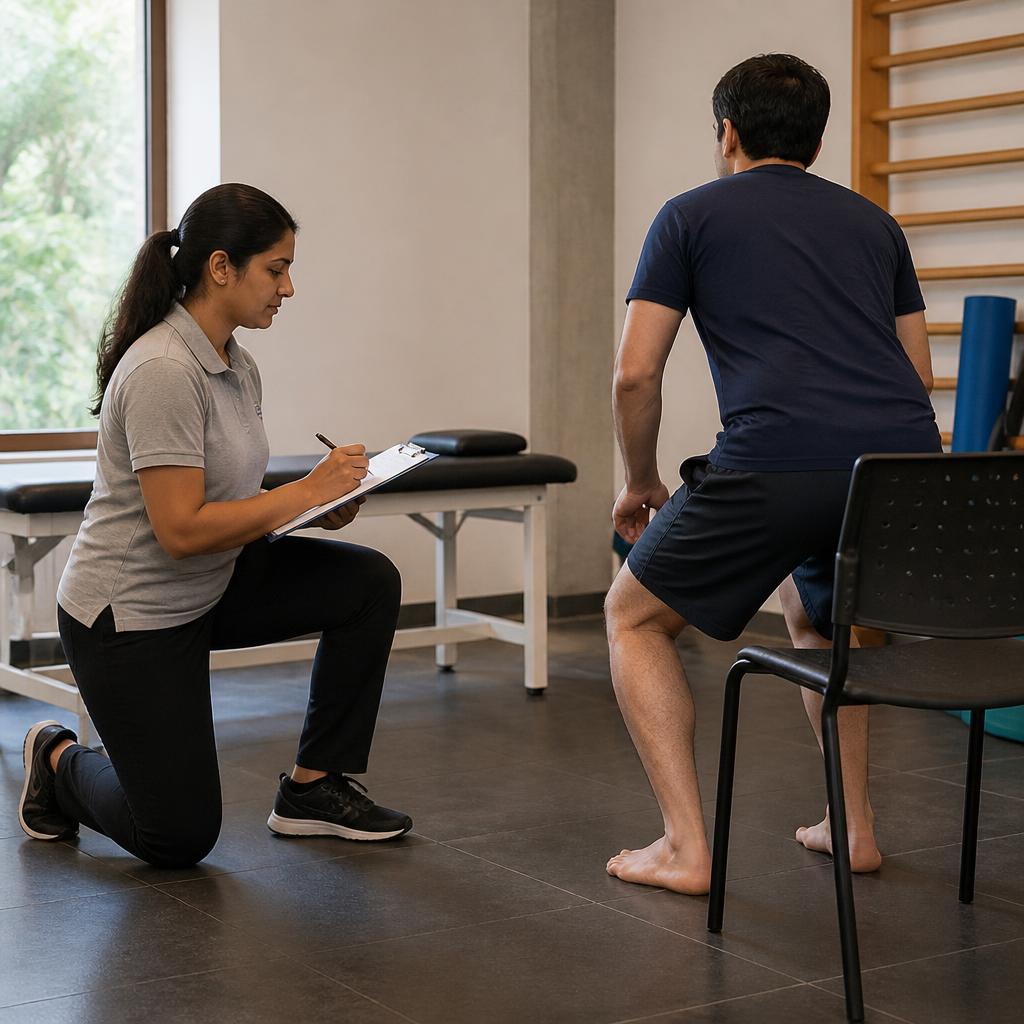
The therapist observes single-task walking, turning, stopping, sit-to-stand, and the person’s ability to follow a simple instruction. Only then might they consider a carefully selected attention or object-handling task. They look for reduced foot clearance, slowed reactions, freezing, loss of balance, confusion, or unsafe divided attention. A new neurological change needs medical review rather than dual-task practice.
How rehabilitation can progress
The first goal may be to keep walking quality stable while the person responds to one simple cue. Progression can change the route, support, speed, or secondary task one at a time, with supervision selected for the person’s risk. The aim is useful everyday function, not a universal counting exercise or a test score that predicts safety everywhere.
What to expect from a home physiotherapy session
A visit can recreate a meaningful doorway turn, bathroom route, or simple carrying task and teach the family how to guard without pulling. The therapist can mark which task is independent, which needs supervision, and which should wait. Practice should stop before attention or walking quality deteriorates.
Do
- Start with the assessed single task, use stable support, remove avoidable hazards, and add only the secondary task the clinician has selected.
- Keep a short record of symptoms, sleep, activity, food or bowel changes where relevant, and the task that is becoming easier or harder.
- Share discharge summaries, medication changes, restrictions, equipment, and new symptoms before a programme is progressed.
Don’t
- Do not practise while carrying hot liquids near stairs, add distractions because another person can, or use a dual-task success as proof that every community route is safe.
- Do not copy another person’s protocol or use one good day as proof that a larger workload is safe.
- Do not delay medical review for a new or rapidly changing symptom because it appears during rehabilitation.
Safety and when to seek medical advice
Seek urgent assessment for sudden weakness, facial drooping, new speech or vision change, collapse, severe headache, or inability to walk. Stop the task and arrange prompt review for repeated near-falls, new confusion, marked freezing, or a sudden change in walking.
Booking and follow-up
Home physiotherapy is arranged after the team understands the person’s condition, location, current precautions, and preferred care. Goswami Rehab offers home visits at ₹1,125–₹1,350 and online consultation at ₹742. Send the online booking request with the main concern, city, and preferred dates; the team confirms the appropriate next step within 24 hours. A teleconsultation can help review a previously assessed plan, but it does not replace emergency or specialist medical care.
This article is educational information only. It does not diagnose a condition or replace advice from a doctor, surgeon, neurologist, pulmonologist, dietitian, or treating physiotherapist. Individual plans, timelines, and outcomes vary.
Related care: home physiotherapy coverage in Amritsar and stroke and neurological rehabilitation.
Clinical sources & further reading
These public resources provide general clinical guidance. They do not replace an assessment or an individual treatment plan.
- Locomotor-cognitive dual-tasking in older adultsPubMed
- Single-task, dual-task and analogy training for gait and balanceNational Library of Medicine
- Falls: assessment and preventionNICE
- FallsNHS
- STEADI older adult fall preventionCenters for Disease Control and Prevention
- Amritsar district: official informationDistrict Administration, Amritsar
Continue exploring
Choose your next step
Keep exploring with a focused guide, a relevant care option, or a direct enquiry.
Need professional advice?
Book an assessment with our expert team.