At a glance
What this guide can help you understand
How Ahmedabad families can connect post-stroke assessment with safer transfers, walking, daily tasks, and home practice.
What should you bring to a consultation?
Share your main concern, when it started, what affects it, current medicines, and any reports or precautions you have been given.
See our clinical assessment approachWhen should you pause and seek medical advice?
Pause routine exercise and seek medical advice for sudden severe change, new neurological symptoms, breathing difficulty, chest pain, major injury, or feeling acutely unwell.
This guide is educational and does not replace diagnosis or urgent care.
After a stroke, physiotherapy in Ahmedabad should connect clinical assessment with the person’s real daily tasks. A plan that only measures a limb in isolation may miss difficulty with attention, vision, communication, transfers, fatigue, or the layout of the home. Rehabilitation is more useful when goals are meaningful, shared with the person and family, and reviewed as needs change.
The practical context in this city
Ahmedabad’s city profile includes post-surgery, stroke, neurological, cardiac, and orthopaedic rehabilitation. That combination is a reminder that two people asking for “stroke physiotherapy” may have very different precautions and priorities. The home environment may include a bathroom threshold, stairs, a lift, a narrow passage, or a caregiver who works during the day. A home visit can test the actual task while keeping the city context practical, without claiming a city-specific stroke rate or outcome.
What a physiotherapist assesses
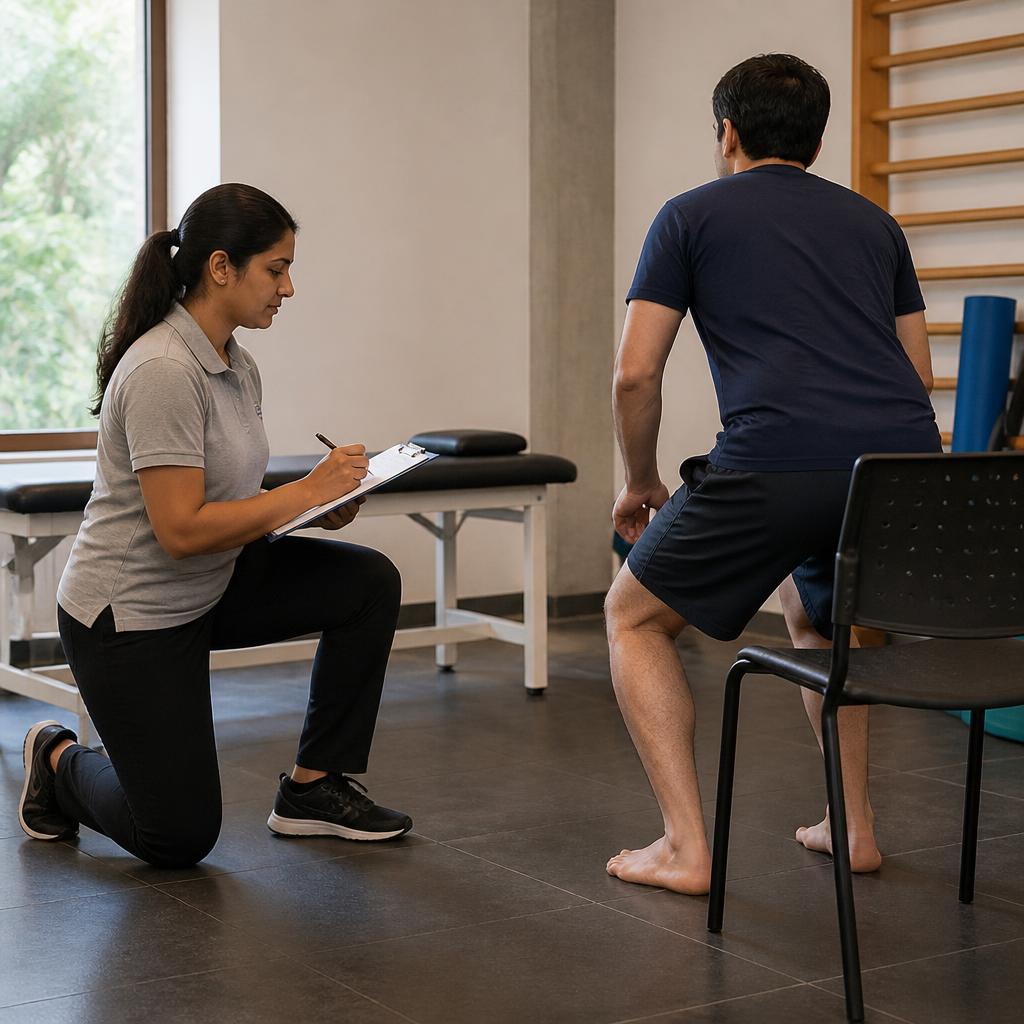
NICE describes stroke rehabilitation as needs-based and goal-oriented. The assessment may include cognition, communication, vision, hearing, tone, strength, sensation, balance, coordination, transfers, walking, upper-limb use, fatigue, and ability to complete daily activities. It should also consider the person’s own goals, carer needs, equipment, and whether the environment supports practice. If a person has pain, new swallowing symptoms, medication changes, or a sudden drop in function, those findings can change the referral pathway before exercise is progressed.
How rehabilitation can progress
Progression should be linked to a function such as standing to dress, reaching for a cup, walking to the bathroom, or getting in and out of a chair. Repetitive, task-specific practice can be included when it matches the person’s deficits and tolerance. The therapist may adjust the amount of assistance, the number of decisions, the distance, the surface, or the speed. A walking aid or caregiver support is not a failure; it may let the person practise more safely while control develops.
What to expect from a home physiotherapy session
The therapist may begin by asking what has changed since the last review and watching a short functional sequence. They can then teach safe positioning, transfers, guarding, and a small set of clinician-selected tasks. The family should learn where to stand and when to stop rather than lifting or pulling through the affected arm. A good plan states what the person can practise independently, what needs supervision, and what should be reviewed at the next visit.
Do
- Choose a meaningful goal, practise in a cleared route, follow the current assistance level, and tell the team about near-falls and tasks that are becoming more difficult.
- Keep a simple record of symptoms, activity, sleep, and the tasks that are becoming easier or harder.
- Share medical reports, medication changes, surgeon restrictions, and any recent change in symptoms before exercise is progressed.
Don’t
- Do not promise a fixed recovery timeline, force a weak arm through a transfer, or continue a generic exercise when attention, balance, alertness, or symptoms have changed.
- Do not copy an exercise from a video if it increases symptoms, requires equipment you cannot control, or conflicts with a medical restriction.
- Do not use pain, fatigue, or a single good day as the only measure of readiness for a harder task.
Safety and when to seek medical advice
Urgent help is needed for new facial drooping, new one-sided weakness or numbness, sudden speech or vision change, new confusion, collapse, or a sudden severe headache. Seek prompt reassessment for repeated falls, new swallowing difficulty, worsening weakness, unsafe transfers, or rapidly declining function. The article cannot determine whether a new symptom is another stroke; a medical service must do that.
Booking and follow-up
Home physiotherapy is arranged after the team understands the person’s condition, location, current precautions, and preferred care. Goswami Rehab offers home visits at ₹1,125–₹1,350 and online consultation at ₹742. Send the online booking request with the main concern, city, and preferred dates; the team confirms the appropriate next step within 24 hours. A teleconsultation can be useful when travel is difficult or when an exercise plan needs review, but it does not replace emergency or specialist medical care.
This article is educational information only. It does not diagnose a condition or replace advice from a doctor, surgeon, dietitian, speech and language therapist, or treating physiotherapist. Individual plans, timelines, and outcomes vary.
Related care: home physiotherapy coverage in Ahmedabad and stroke and neurological rehabilitation.
Clinical sources & further reading
These public resources provide general clinical guidance. They do not replace an assessment or an individual treatment plan.
- Stroke rehabilitation in adults: recommendationsNICE
- Postoperative rehabilitationNICE
- Guidelines for Adult Stroke Rehabilitation and RecoveryAmerican Heart Association/American Stroke Association
- Ahmedabad district: official district informationDistrict Administration, Ahmedabad
- The principles of home care for patients with stroke: an integrative reviewNational Library of Medicine
- Stroke rehabilitation in adultsNICE
Continue exploring
Choose your next step
Keep exploring with a focused guide, a relevant care option, or a direct enquiry.
Need professional advice?
Book an assessment with our expert team.