At a glance
What this guide can help you understand
Learn how caregivers can prepare bed-to-chair transfers, repositioning, equipment, and body mechanics more safely at home in Delhi.
What should you bring to a consultation?
Share your main concern, when it started, what affects it, current medicines, and any reports or precautions you have been given.
See our clinical assessment approachWhen should you pause and seek medical advice?
Pause routine exercise and seek medical advice for sudden severe change, new neurological symptoms, breathing difficulty, chest pain, major injury, or feeling acutely unwell.
This guide is educational and does not replace diagnosis or urgent care.
A caregiver may help someone move many times a day after surgery, stroke, illness, or a period of reduced mobility. A transfer is safest when the person can participate, the route is prepared, and the technique matches their strength, weight-bearing status, cognition, and equipment. Lifting under the arms is not a universal solution.
The practical context in this city
Delhi households may manage a bed, chair, bathroom, stairs, lift, and vehicle transfer within a small or busy routine. A home assessment can identify the one transfer that creates the greatest risk and solve that first. The therapist should account for available helpers and should never assume that a family member can safely provide more force than they can.
What a physiotherapist assesses
The therapist checks alertness, pain, weight-bearing restrictions, trunk and leg control, arm use, balance, dizziness, lines or tubes, footwear, bed height, chair brakes, and the caregiver’s own physical limitations. They determine whether one helper, two helpers, a board, a hoist, a rail, or a different sequence is appropriate. Equipment must be fitted and taught, not merely recommended.
How rehabilitation can progress
The person should be encouraged to do the part they can do safely: rolling, pushing through the arm, bringing the feet under the body, or reaching for a stable surface. Practice may progress from a high, stable surface to a lower one and from predictable to more functional transfers. Caregiver assistance should reduce as control improves, but only after the movement is reliable.
What to expect from a home physiotherapy session
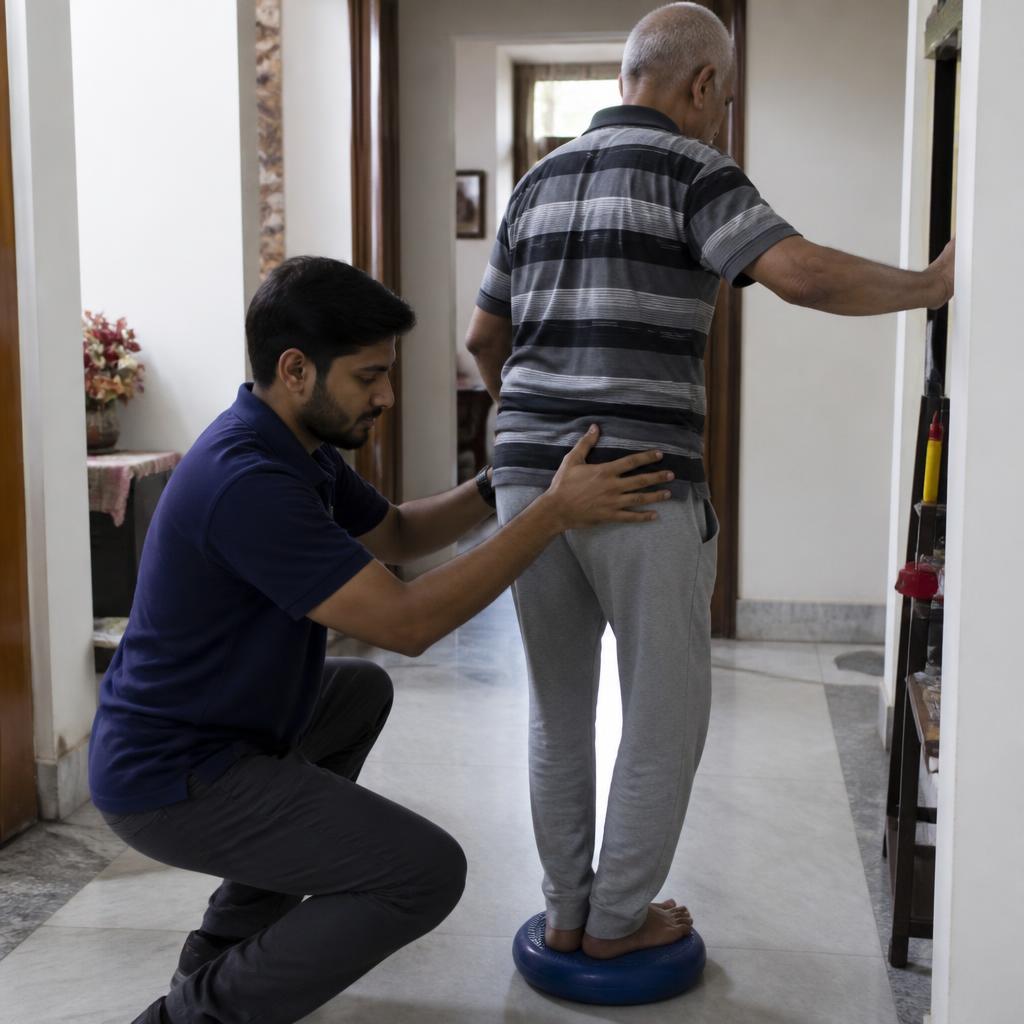
The therapist watches the exact bed-to-chair or toilet transfer, stops unsafe attempts, and teaches setup, communication, guarding, and the agreed count. The caregiver practises while the therapist observes their foot position and back load. A written fallback plan explains what to do if the person is suddenly too weak to complete the transfer.
Do
- Lock wheels, clear the route, explain the plan, use stable footwear, and let the person move at their own speed while the caregiver guards rather than pulls.
- Keep a simple record of symptoms, activity, sleep, and the tasks that are becoming easier or harder.
- Share medical reports, medication changes, surgeon restrictions, and any recent change in symptoms before exercise is progressed.
Don’t
- Do not twist while lifting, pull on a weak arm, improvise with a plastic stool, or attempt a two-person transfer alone when the assessment requires more support.
- Do not copy an exercise from a video if it increases symptoms, requires equipment you cannot control, or conflicts with a medical restriction.
- Do not use pain, fatigue, or a single good day as the only measure of readiness for a harder task.
Safety and when to seek medical advice
Any of these events—a fall, new severe pain, suspected fracture, head impact, sudden weakness, chest pain, or breathing difficulty—requires medical attention. If a caregiver develops back pain, numbness, or repeated near-injuries, the transfer plan needs urgent review.
Booking and follow-up
Home physiotherapy is arranged after the team understands the person’s condition, location, current precautions, and preferred care. Goswami Rehab offers home visits at ₹1,125–₹1,350 and online consultation at ₹742. Send the online booking request with the main concern, city, and preferred dates; the team confirms the appropriate next step within 24 hours. A teleconsultation can be useful when travel is difficult or when an exercise plan needs review, but it does not replace emergency or specialist medical care.
The article is educational information only. It does not diagnose a condition or replace advice from a doctor, surgeon, obstetrician, cancer team, or treating physiotherapist. Individual plans, timelines, and outcomes vary.
Clinical sources & further reading
These public resources provide general clinical guidance. They do not replace an assessment or an individual treatment plan.
- Manual handling at workHealth and Safety Executive
- Assistive technologyWorld Health Organization
- PhysiotherapyNHS
- Government of National Capital Territory of DelhiDelhi Government
- RehabilitationMedlinePlus, U.S. National Library of Medicine
- Neurologic diseasesMedlinePlus, U.S. National Library of Medicine
Continue exploring
Choose your next step
Keep exploring with a focused guide, a relevant care option, or a direct enquiry.
Need professional advice?
Book an assessment with our expert team.