At a glance
What this guide can help you understand
COPD affects breathing, activity tolerance, and daily life. Pulmonary physiotherapy at home may support breathlessness management, pacing, and confidence with daily activity alongside medical care.
What should you bring to a consultation?
Share your main concern, when it started, what affects it, current medicines, and any reports or precautions you have been given.
See our clinical assessment approachWhen should you pause and seek medical advice?
Pause routine exercise and seek medical advice for sudden severe change, new neurological symptoms, breathing difficulty, chest pain, major injury, or feeling acutely unwell.
This guide is educational and does not replace diagnosis or urgent care.
Chronic Obstructive Pulmonary Disease (COPD) can affect breathing, activity tolerance, and participation in daily life. Pulmonary rehabilitation combines education, breathing strategies, exercise, and pacing, and should be planned with the person's medical team.
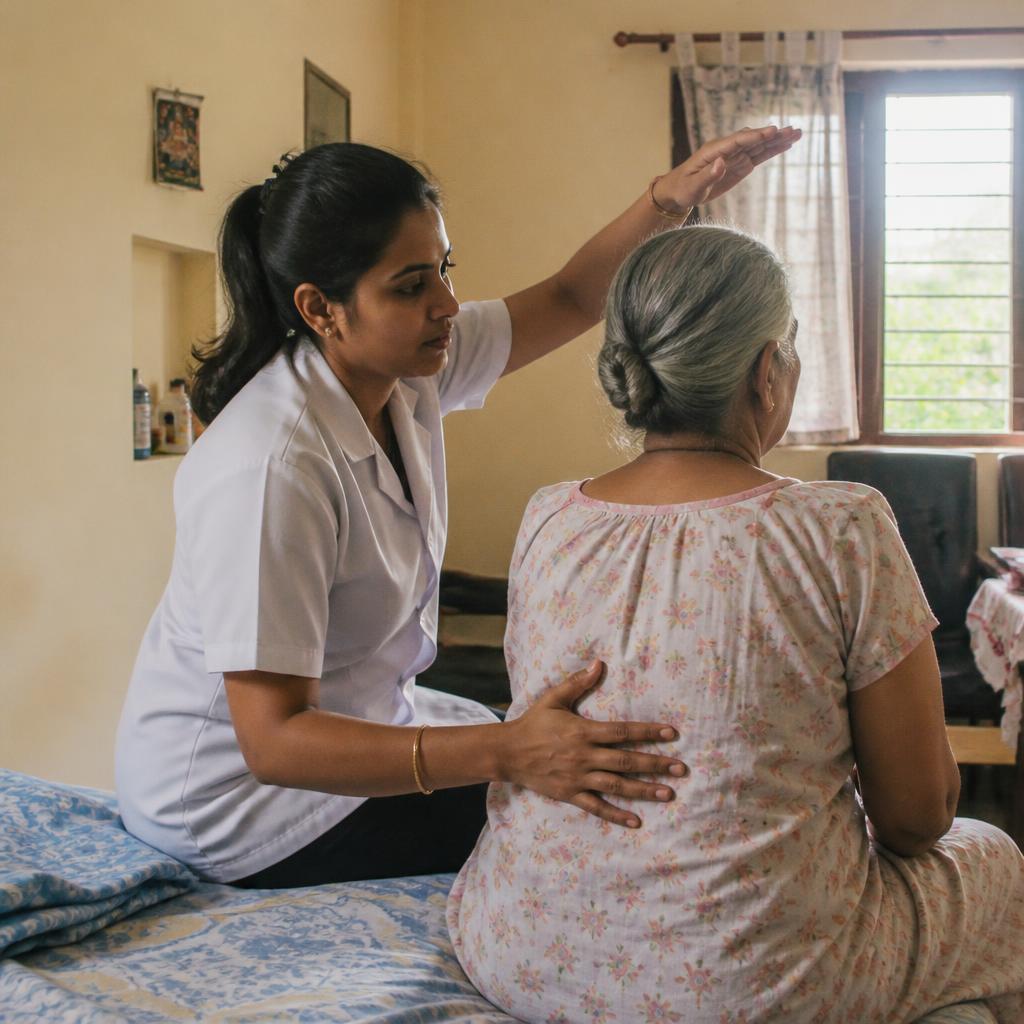
Pulmonary physiotherapy at home may make rehabilitation more accessible when travel, fatigue, or breathlessness make clinic visits difficult. The program can include breathing rehabilitation, airway-clearance guidance, and graded exercise adapted to the person's symptoms and medical advice.
COPD and Pulmonary Physiotherapy
COPD is an umbrella term for progressive lung conditions — primarily chronic bronchitis and emphysema — characterised by airflow limitation that is not fully reversible. The primary causes are long-term smoking and occupational dust or chemical exposure.
The central symptom is breathlessness (dyspnoea) — initially on exertion, and in advanced disease, at rest. Chronic cough, sputum production, and repeated chest infections (exacerbations) are common. A sudden or severe change in symptoms needs medical assessment rather than an exercise adjustment alone.
What Pulmonary Physiotherapy Does
1. Breathing Retraining
Most COPD patients develop inefficient breathing patterns — rapid, shallow breathing that uses the accessory muscles (neck and shoulder muscles) rather than the diaphragm. This is exhausting and less effective at moving air.
Pulmonary physiotherapy re-establishes diaphragmatic breathing:
- Pursed-lip breathing: Breathing out through pursed lips can slow exhalation and may make breathlessness feel more manageable for some people
- Diaphragmatic breathing: Breathing practice may help some people coordinate their breathing, but it should be individualised rather than forced
- Positions of ease: Forward-lean positions that fix the shoulder girdle allow the accessory muscles to assist breathing more efficiently during acute breathlessness
2. Airway Clearance Techniques
Excessive mucus production is a hallmark of chronic bronchitis. Retained secretions increase infection risk and block airflow. Physiotherapy teaches and supervises:
- Active Cycle of Breathing Technique (ACBT): A structured sequence of breathing exercises that mobilises secretions from small to large airways for expectoration
- Autogenic drainage: A self-management technique using controlled breathing at different lung volumes to shift secretions
- Positioning: Gravity-assisted drainage positions for patients with significant sputum retention
3. Exercise Training
Exercise training is an important part of pulmonary rehabilitation and can support breathlessness management, exercise capacity, and quality of life in COPD when progressed safely.
The physiological logic: COPD patients become breathless with exertion, so they reduce activity, which leads to deconditioning, which makes them more breathless with less exertion — a vicious cycle. Exercise training breaks this cycle.
Homecare exercise programs include:
- Walking programs with structured progression
- Lower limb strengthening (the most evidence-supported component)
- Upper limb training (important for tasks like washing hair and reaching shelves)
- Interval training for patients who cannot sustain continuous exercise
4. Energy Conservation
Fatigue and breathlessness limit the amount of energy available for daily activities. Occupational therapy principles applied within physiotherapy teach patients to:
- Prioritise and sequence activities to manage energy across the day
- Use breathing techniques during specific activities (stairs, bending, lifting)
- Pace household tasks and plan rest periods
Managing Exacerbations
Acute exacerbations are periods of worsening symptoms, often triggered by infection or other factors. During an exacerbation, medical assessment takes priority; our homecare team may support rehabilitation after the acute phase:
- Increased airway clearance to manage excess secretions
- Supervised breathing techniques during acute breathlessness
- Monitoring for deterioration requiring medical escalation
- Post-exacerbation rehabilitation to restore function lost during the acute period
What Evidence Supports Pulmonary Rehabilitation?
Pulmonary rehabilitation is supported by clinical research for improving exercise capacity, breathlessness, and quality of life for many people with COPD. The size and duration of benefit vary, so a clinician should help decide whether a program is suitable.
At Goswami Rehab, we provide homecare pulmonary physiotherapy for COPD patients across India. Our programs are tailored to disease severity, comorbidities, and each patient's daily life demands.
Clinical sources & further reading
These public resources provide general clinical guidance. They do not replace an assessment or an individual treatment plan.
Continue exploring
Choose your next step
Keep exploring with a focused guide, a relevant care option, or a direct enquiry.
For this topic, see the cardiopulmonary service overview.
Need professional advice?
Book an assessment with our expert team.