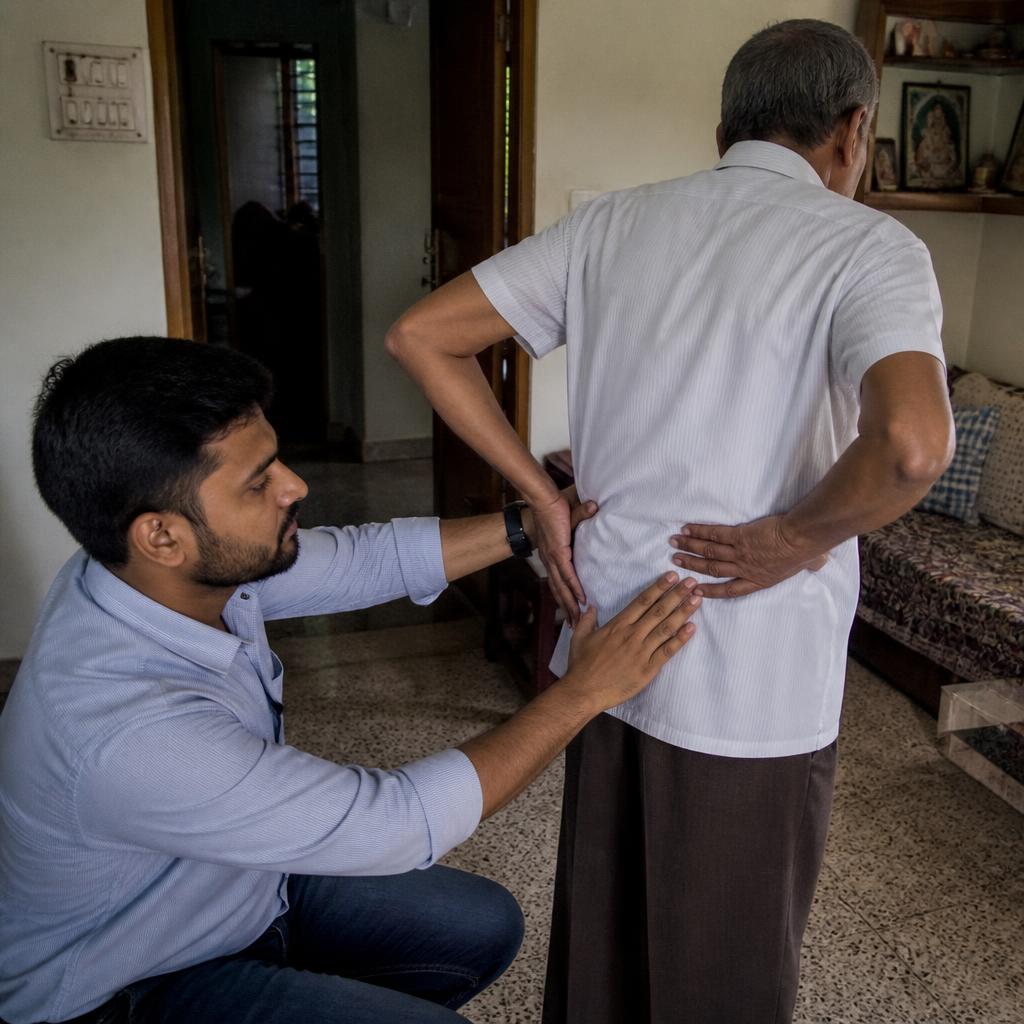
At a glance
Symptoms can guide questions, not confirm a disc level
L3–L4, L4–L5, and L5–S1 patterns can overlap. Assessment, strength testing, symptom history, and urgent warning signs matter more than trying to match pain to one level on an MRI report.
Compare carefully
Common lumbar levels and what they may affect
These are broad patterns, not a self-diagnosis tool. Pain can be referred, multiple levels can coexist, and other conditions can feel similar.
Get urgent medical help
Do not wait for routine physiotherapy if warning signs appear
New bladder or bowel changes, numbness around the saddle area, rapidly worsening weakness, severe symptoms after major trauma, fever with severe back pain, or unexplained weight loss need prompt medical assessment.
Do
Prepare for an assessment
- Note when symptoms began, what changes them, and whether strength or walking has changed.
- Bring scan reports and a medication list if they are available.
- Use comfortable movement within tolerable limits unless a clinician has given different advice.
Don’t
Chase a level from pain alone
- Do not force stretches or exercises that clearly worsen leg symptoms or weakness.
- Do not treat one MRI finding as the complete explanation of your symptoms.
- Do not delay urgent review while trying a home programme.
What happens in a careful consultation?
A clinician reviews symptoms, movement, strength, sensation, reflexes, function, and relevant medical history.
The plan may include education, pacing, graded activity, and referral or medical review when the findings call for it.
When can home physiotherapy help?
After appropriate screening, home visits can support movement confidence, everyday activity, and an individualised rehabilitation plan.
Explore homecare physiotherapy“Slipped disc” is the everyday phrase people often use for a disc bulge, protrusion, extrusion, or prolapse in the spine. The disc is a cushion between two vertebrae. If part of the disc irritates or compresses a nearby nerve root, a person may feel back pain with pain, tingling, numbness, or weakness in the leg. But a disc finding on a scan is not automatically the source of pain, and some disc changes cause no symptoms at all.
This matters because searches for “L3–L4 slipped disc symptoms” or “L5–S1 disc pain” can make a level sound like a diagnosis. Pain maps overlap, disc shape and location change which root is contacted, and other conditions can produce very similar symptoms. This guide explains the common patterns without trying to diagnose a particular person from a symptom checklist.
What people mean by a lumbar slipped disc
The lumbar spine is the lower part of the back. Its five vertebrae are commonly labelled L1 to L5, followed by the sacrum. The discs are named for the vertebrae above and below them: L3–L4 sits between the third and fourth lumbar vertebrae, L4–L5 between the fourth and fifth, and L5–S1 between L5 and the top of the sacrum.
A posterolateral or paracentral disc herniation usually affects the nerve root travelling past that disc level. In that common pattern, an L3–L4 herniation may affect the traversing L4 root, L4–L5 may affect L5, and L5–S1 may affect S1. A foraminal or far-lateral herniation can affect the exiting root instead. The position of the disc material therefore matters as much as the disc label.
Pain can also come from irritated tissues around the disc without a clear nerve-root deficit. Some people have mostly local back pain; others have leg pain that is more troublesome than the back pain. A clinician should separate these patterns from hip, sacroiliac, muscle, facet-joint, spinal-stenosis, fracture, infection, inflammatory, or visceral causes.
What L3–L4, L4–L5, and L5–S1 patterns can look like
These are teaching patterns, not self-diagnosis rules. Symptoms may be incomplete, mixed, on both sides, or different from a textbook diagram.
- L3–L4 disc level: A typical paracentral herniation may irritate L4. Symptoms can include back pain travelling toward the front of the thigh or medial knee and leg, altered sensation in a similar area, difficulty with knee extension, or a change in the patellar reflex. A far-lateral L3–L4 herniation may instead affect the exiting L3 root and produce a different pattern.
- L4–L5 disc level: A typical paracentral herniation may irritate L5. Pain or tingling may travel through the buttock and outer thigh or calf toward the top of the foot or big toe. Weakness may affect ankle or big-toe lifting, and heel-walking may become difficult. L4 symptoms are possible when the herniation is foraminal or far lateral.
- L5–S1 disc level: A typical paracentral herniation may irritate S1. Symptoms may travel from the buttock through the back or outer part of the thigh and calf toward the outer or sole of the foot. Weakness may affect pushing the foot down or repeated toe raises, and the Achilles reflex may change.
These patterns overlap substantially. Research on MRI-confirmed L5 and S1 radiculopathy found that pain distributions were not reliably specific enough to identify the affected root from a pain drawing alone. The useful question is not “Which level does my pain prove?” but “Do the history, neurological examination, and—when needed—imaging fit together?”
Other common lower-back and lumbar disc pain patterns
Lumbar disc-related problems do not all produce classic sciatica. Common presentations include:
- Local mechanical low-back pain: aching, stiffness, guarding, or pain with particular movements without clear numbness or weakness in a nerve-root pattern.
- Radicular leg pain: sharp, burning, electric, or shooting pain that travels below the buttock and may be accompanied by tingling or altered sensation.
- Radiculopathy: radicular symptoms plus objective neurological change such as measurable weakness, sensory loss, or a reflex difference. This requires clinical examination.
- Referred leg or buttock pain: pain that spreads away from the back but does not behave like a nerve-root problem. Muscles, joints, the hip, sacroiliac region, and other structures can refer pain.
- Pain aggravated by sitting, bending, coughing, or sneezing: this can occur with disc-related irritation, but it is not specific enough to confirm a disc herniation.
- Walking-related leg symptoms: pain, heaviness, or numbness that changes with standing or walking can also reflect spinal stenosis or another condition, particularly in older adults.
A scan may show degeneration, bulging, or a herniation in someone who has no pain. The finding becomes clinically useful when its location and severity fit the symptoms and examination and when knowing about it would change management.
What a physiotherapist assesses
The assessment starts with the person’s story: when symptoms began, whether there was a lift, fall, or gradual change, where the pain travels, what happens with sitting or walking, and how symptoms behave later that day and the next morning. The therapist also asks about sleep, work, driving, lifting, exercise, previous episodes, surgery, medication, fever, unexplained weight loss, cancer history, infection risk, steroid or immune-suppressing treatment, and recent trauma.
The physical assessment may include walking, sit-to-stand, spinal movement, hip movement, strength, sensation, reflexes, balance, and a safe version of a task that matters to the person. Depending on the presentation, a clinician may use straight-leg raise or femoral-nerve tension testing. These tests are not magic level detectors. Individual examination findings can have limited accuracy, so the clinician combines several findings with the history and decides whether medical review or imaging is needed.
The assessment should also look for reasons not to treat the problem as a routine musculoskeletal episode. New bladder or bowel change, saddle-area numbness, progressive weakness, fever, a history of cancer, major trauma, or systemic illness changes the urgency of the plan.
Imaging and other tests
An MRI can show discs, nerve roots, and other soft tissues, but an MRI report should not be read in isolation. Common age-related findings can be present without symptoms. NICE advises against routine imaging for low-back pain or sciatica in a non-specialist setting; specialist imaging is considered when the result is likely to change management. The American College of Radiology similarly supports imaging when red flags raise concern for serious disease or when symptoms persist despite an appropriate trial of care.
Imaging becomes more important when there is a progressive neurological deficit, suspected cauda equina syndrome, serious trauma, infection or cancer risk, or persistent disabling leg symptoms where an injection or surgical opinion is being considered. The appropriate test and timing belong to the medical team. A normal or non-matching scan does not mean the symptoms are imaginary, and an abnormal scan does not prove that every symptom comes from the disc.
How rehabilitation can progress
Phase 1: understand irritability and protect useful movement
When symptoms are highly irritable, the first aim is to reduce the loads that repeatedly flare the back or leg while keeping safe movement in the day. That may mean shorter sitting periods, changing position, reducing repeated bending and twisting, temporarily modifying heavy lifting, and using brief, comfortable walks if walking is tolerated. Prolonged bed rest is not a routine treatment. If a position or movement increases electric pain, numbness, or weakness, stop testing it repeatedly and ask for an assessment.
Pain relief, anti-inflammatory medicine, or other medication decisions should be discussed with a doctor or pharmacist because suitability depends on age, pregnancy, kidney, stomach, heart, liver, and other health factors. Do not use someone else’s prescription or assume that a medicine is safe because it helped another person.
Phase 2: restore comfortable movement and confidence
Once symptoms are calm enough, a physiotherapist may select comfortable spinal or hip movement, breathing and relaxation strategies, walking, gentle trunk or hip activation, and task practice. There is no single “best” exercise for every disc level. NICE recommends exercise and movement matched to the person’s needs, preferences, and capabilities. Manual therapy, if used, should be part of a wider package that includes exercise and education rather than a stand-alone promise of correction.
Neural-mobility exercises may be appropriate for some people, but they should be taught and adjusted by a clinician. They should not be forced into sharp, electric, or increasingly distant symptoms. Traction, belts, corsets, electrotherapy, and a named online programme should not be presented as universal solutions.
Phase 3: rebuild capacity for daily life
Later rehabilitation can gradually increase walking time, strength, trunk and hip control, lifting tolerance, stairs, work tasks, and exercise. Change one or two variables at a time—such as duration, load, range, speed, or frequency—and observe the response during the task, later that day, and the next morning. A mild, settling response may be manageable; steadily worsening leg pain, spreading numbness, new weakness, or a clear loss of function needs review rather than a harder workout.
The goal is not to force a disc back into place. The goal is to help the person move more safely and confidently, restore capacity, and participate in the activities that matter while the medical team monitors the clinical picture.
Work, sitting, lifting, and sleep
There is no universal sitting limit, mattress, sleeping position, lifting weight, or return-to-work date for every lumbar disc problem. A practical plan can use position changes, short movement breaks, a temporary reduction in repeated bending or twisting, load held close to the body, help with heavier objects, and a staged return to work when the job allows it. A person who drives, works at a desk, lifts at work, cares for a child, or works on the floor may need a different progression.
Sleep advice should focus on comfort and enough recovery to function. Pillows, side-lying, back-lying, heat, or cold can be discussed as comfort options if they are safe for the person’s skin and medical situation, but none should be described as a way to repair a disc. If night pain is new, severe, or worsening, medical review is more important than changing the mattress.
What to expect from a home physiotherapy session
A home session begins with a review of medical history, reports, medication changes, red flags, symptom behaviour, and the tasks the person needs to do at home. The physiotherapist may observe getting out of bed, sitting, walking to the bathroom, climbing stairs, lifting a light object, or setting up a workstation. The assessment is adapted to irritability; a person with severe leg pain does not need to repeatedly perform provocative tests.
The plan may include education, a small number of exercises, walking or position-change practice, task modification, and a clear rule for what to do if symptoms flare. Follow-up should track function as well as pain: walking distance, sitting tolerance, sleep, work, strength, confidence, and whether numbness or weakness is changing. An online consultation may help with education or review of an existing plan, but it cannot replace urgent care or an in-person neurological assessment when that is needed.
Do
- Keep moving within a tolerable range and change position regularly rather than staying in bed for long periods without medical advice.
- Take reports, medication lists, and the timeline of symptoms to a doctor or physiotherapist.
- Notice whether symptoms are settling, spreading, becoming more intense, or accompanied by new weakness or numbness.
- Ask for a work, lifting, driving, or home plan that matches the actual tasks you need to perform.
- Seek a clinician’s guidance before progressing a nerve-mobility exercise, heavy lifting, running, or contact sport.
Don’t
- Do not diagnose the disc level from the location of leg pain or a social-media dermatome chart.
- Do not repeatedly force a painful bend, stretch, nerve glide, or “disc relocation” exercise.
- Do not stay completely inactive because a scan uses alarming words, and do not push through progressive neurological symptoms because movement is usually encouraged.
- Do not assume that traction, a brace, massage, injection, supplement, or operation is appropriate without a clinical discussion.
- Do not delay urgent assessment while waiting for a home physiotherapy appointment or online exercise plan.
Safety and when to seek medical advice
Go to emergency care now for back pain with numbness around the genitals or saddle area, new difficulty passing urine or urinary retention, loss of bladder or bowel control, rapidly worsening weakness, major loss of feeling in one or both legs, or symptoms after a serious accident. These can indicate a time-sensitive problem such as cauda equina syndrome or serious spinal injury.
Arrange prompt medical review for progressive weakness or numbness, fever or feeling systemically unwell, unexplained weight loss, pain that is severe or worse at night, a new swelling, a history of cancer, significant infection risk, or pain that is not improving as expected. A doctor may decide that blood tests, imaging, medication review, specialist referral, or another diagnosis needs consideration.
Physiotherapy is not a substitute for emergency or specialist care. Rehabilitation can be useful when the assessment supports it, but the plan must change when the neurological or medical picture changes.
When specialist or surgical review may be discussed
Most uncomplicated episodes are initially managed without surgery, using education, symptom management, activity modification, and an individualized rehabilitation plan. The time course varies, so a general statistic should not be turned into a promise for one person. If disabling leg pain or functional loss persists despite appropriate non-surgical care, and imaging matches the clinical findings, a medical team may discuss injections or spinal decompression.
Earlier specialist or surgical review may be needed for severe or progressive motor weakness or cauda equina symptoms. Surgery can provide faster relief for selected patients, while longer-term results and the need for surgery depend on the diagnosis, duration, severity, imaging, preferences, and risks. This decision belongs with the appropriate doctor or spine team—not with an online symptom score.
Booking and follow-up
Home physiotherapy is arranged after the team understands the person’s symptoms, location, current precautions, and preferred care. Goswami Rehab offers home visits at ₹1,125–₹1,350 and online consultation at ₹742. Send the online booking request with the main concern, city, and preferred dates; the team confirms the appropriate next step within 24 hours. A teleconsultation can be useful when travel is difficult or when an exercise plan needs review, but it does not replace emergency or specialist medical care.
This article is educational information only. It does not diagnose a condition or replace advice from a doctor, spine specialist, pharmacist, or treating physiotherapist. Individual plans, timelines, and outcomes vary.
Further reading
The clinical sources below include national guidance, an imaging guideline, peer-reviewed diagnostic research, and a review of lumbar disc-herniation treatment guidance. They are included so readers can check the evidence directly.
Clinical sources & further reading
These public resources provide general clinical guidance. They do not replace an assessment or an individual treatment plan.
- Lumbar Disc HerniationNCBI Bookshelf, National Library of Medicine
- Where do patients with MRI-confirmed single-level radiculopathy experience pain?Chiropractic & Manual Therapies / PubMed Central
- Accuracy of physical examination for chronic lumbar radiculopathyBMC Musculoskeletal Disorders / PubMed Central
- ACR Appropriateness Criteria® Low Back Pain: 2021 UpdateAmerican College of Radiology / PubMed
- Low back pain and sciatica in over 16s: assessment and managementNational Institute for Health and Care Excellence (NICE)
- Slipped discNHS
- The Essence of Clinical Practice Guidelines for Lumbar Disc Herniation, 2021: 4. TreatmentSpine Surgery and Related Research / PubMed Central
- Prognostic factors for treatment success of conservative management and role for physiotherapy in radicular pain caused by a lumbar disc herniationSystematic review / PubMed Central
Continue exploring
Choose your next step
Keep exploring with a focused guide, a relevant care option, or a direct enquiry.
Need professional advice?
Book an assessment with our expert team.