At a glance
What this guide can help you understand
How Pune patients can prepare for stairs, a building entrance, transport, work, and daily travel after surgery without relying on a fixed return date.
What should you bring to a consultation?
Share your main concern, when it started, what affects it, current medicines, and any reports or precautions you have been given.
See our clinical assessment approachWhen should you pause and seek medical advice?
Pause routine exercise and seek medical advice for sudden severe change, new neurological symptoms, breathing difficulty, chest pain, major injury, or feeling acutely unwell.
This guide is educational and does not replace diagnosis or urgent care.
Getting from a Pune home to work, a family errand, or a follow-up appointment after surgery is a functional rehabilitation problem, not simply a question of whether the person can walk indoors. Stairs, a lift, uneven ground, a vehicle transfer, waiting, carrying a small item, and fatigue may all change the task. Readiness should be discussed with the surgical and rehabilitation team rather than decided by a calendar date.
The practical context in this city
Pune is used here as the practical setting for community mobility, not as evidence of a local outcome or transport risk. A home visit can examine the route the person actually needs: bedroom to bathroom, one floor to another, the building entrance, a vehicle, or a short work-related path. Operation type, weight-bearing status, wound status, pain, equipment, job demands, and the surgeon’s restrictions determine what can be practised.
What a physiotherapist assesses
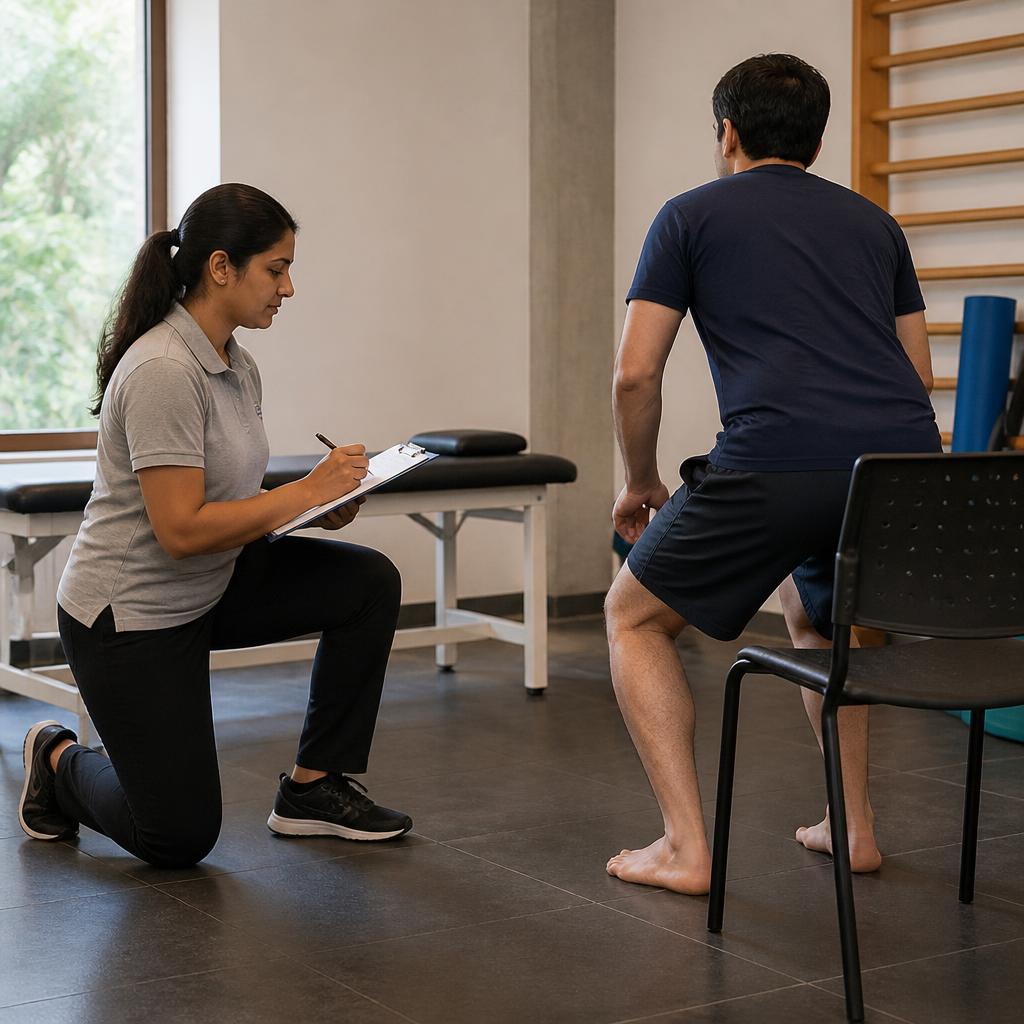
The physiotherapist reviews the discharge summary and restrictions before observing transfers, standing, walking, turning, step control, and the use of a railing or walking aid. The assessment may include the person’s confidence, attention, vision, dizziness, pain response, footwear, and ability to manage a pause. Work and travel questions should be specific: How long is the route? Is there a seat? Are stairs unavoidable? Can the person carry anything? A general article cannot answer those questions without an individual assessment.
How rehabilitation can progress
Practice can move from a controlled indoor task to the next safe part of the route, with the clinician deciding how much support is appropriate. A stair task is taught according to the procedure and weight-bearing instruction, not a universal sequence copied online. Community readiness may involve managing a doorway, a lift, a vehicle transfer, a short wait, and recovery afterward. Progress is demonstrated by safer control and repeatability, not by completing a difficult route once.
What to expect from a home physiotherapy session
The therapist may set up a rail, chair, walking aid, lighting, or rest point and then teach the person and caregiver where to stand. They can rehearse the exact turn, threshold, stair, or vehicle movement that matters. The plan should distinguish tasks that are safe alone, safe with supervision, and not yet appropriate. Follow-up can then review wound changes, swelling, pain, confidence, and the response after community practice.
Do
- Keep the surgeon’s restrictions available, clear the route, practise the real task at the assessed assistance level, and plan a recovery period after community travel.
- Keep a short record of symptoms, sleep, activity, and the daily task that is becoming easier or harder.
- Share discharge summaries, medication changes, restrictions, and new symptoms before a programme is progressed.
Don’t
- Do not use a stair video to override weight-bearing or movement restrictions, carry a bag before the team has assessed it, or promise a return-to-work date from walking ability alone.
- Do not copy a protocol from another person or use a good day as proof that a larger workload is safe.
- Do not delay medical review for a new or rapidly changing symptom because it appears during rehabilitation.
Safety and when to seek medical advice
Seek urgent medical review for wound discharge, fever, sudden loss of function, marked swelling, new calf pain, chest pain, fainting, severe breathlessness, or a new neurological symptom. Pause community practice when dizziness, pain, or instability makes the route unsafe. A sudden change after surgery needs medical assessment rather than a harder home exercise session.
Booking and follow-up
Home physiotherapy is arranged after the team understands the person’s condition, location, current precautions, and preferred care. Goswami Rehab offers home visits at ₹1,125–₹1,350 and online consultation at ₹742. Send the online booking request with the main concern, city, and preferred dates; the team confirms the appropriate next step within 24 hours. A teleconsultation can help review a previously assessed plan, but it does not replace emergency or specialist medical care.
This article is educational information only. It does not diagnose a condition or replace advice from a doctor, surgeon, cardiologist, neurologist, dietitian, or treating physiotherapist. Individual plans, timelines, and outcomes vary.
Related care: home physiotherapy coverage in Pune and post-surgery rehabilitation.
Clinical sources & further reading
These public resources provide general clinical guidance. They do not replace an assessment or an individual treatment plan.
- Rehabilitation after critical illness in adultsNICE
- Rehabilitation after traumatic injuryNICE
- Postoperative rehabilitation after primary joint replacementNICE
- Activities after total hip replacementAmerican Academy of Orthopaedic Surgeons
- Taking a patient onto the stairsNHS Lothian
- Post-operative spinal surgery physiotherapyNHS Greater Glasgow and Clyde
- Pune district: official informationDistrict Administration, Pune
Continue exploring
Choose your next step
Keep exploring with a focused guide, a relevant care option, or a direct enquiry.
Need professional advice?
Book an assessment with our expert team.