At a glance
What this guide can help you understand
A practical home rehabilitation guide to wheelchair positioning, transfers, pressure relief, and caregiver coaching for people in Faridabad.
What should you bring to a consultation?
Share your main concern, when it started, what affects it, current medicines, and any reports or precautions you have been given.
See our clinical assessment approachWhen should you pause and seek medical advice?
Pause routine exercise and seek medical advice for sudden severe change, new neurological symptoms, breathing difficulty, chest pain, major injury, or feeling acutely unwell.
This guide is educational and does not replace diagnosis or urgent care.
A wheelchair is not only a way to sit and move. Fit, posture, propulsion, transfers, skin checks, and the person’s goals all influence whether it supports independence or creates new strain. Home rehabilitation can help a person and caregiver practise the small skills that make a daily route safer.
The practical context in this city
A Faridabad home may have a lift, steps, a threshold, a compact bathroom, or a preferred floor-level activity. The plan must begin with the person’s actual route and equipment, not with a promise that every doorway can be adapted. If a ramp, cushion, commode, or transfer board is being considered, the therapist should assess fit and the person’s ability to use it before it is purchased.
What a physiotherapist assesses
The therapist reviews the reason for wheelchair use, skin history, sitting tolerance, pain, hand and shoulder strength, trunk control, vision, cognition, and transfer precautions. The chair’s seat width, depth, foot support, brakes, cushion, and propulsion position are checked. A person who can push on a smooth floor may still need a different strategy for a threshold or crowded route.
How rehabilitation can progress
Training can start with brakes, foot placement, posture changes, and pressure relief using the method that the person can perform reliably. It can progress to bed and chair transfers, turning in a confined space, reaching for objects, and negotiating a known doorway with supervision. Pressure relief is individual: a lift, lean, tilt, or weight shift must be taught according to strength, equipment, skin condition, and medical restrictions.
What to expect from a home physiotherapy session
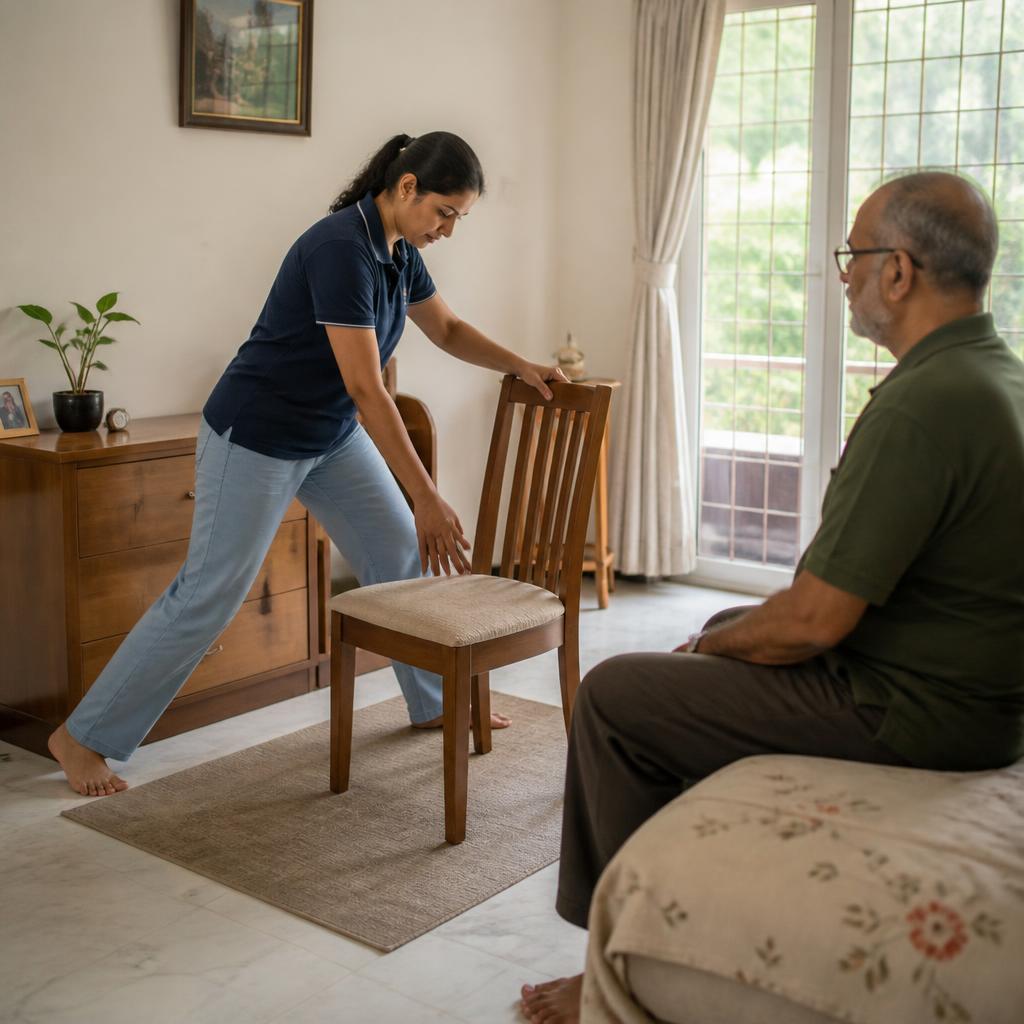
The therapist marks the safest practice area, checks the chair on the surfaces the person actually uses, and teaches a caregiver how to set up without taking over. Skin inspection and a short pressure-relief routine are rehearsed, then a small home task—such as moving from bed to chair or reaching a wash area—is repeated with feedback. Progress is recorded by assistance level and safety, not only by distance.
Do
- Check skin every day, lock the brakes before transfers, keep feet and clothing clear of the wheels, and ask for equipment review when posture or pressure changes.
- Keep a simple record of symptoms, activity, sleep, and the tasks that are becoming easier or harder.
- Share medical reports, medication changes, surgeon restrictions, and any recent change in symptoms before exercise is progressed.
Don’t
- Do not lift a person under the arms, sit on a cushion that is not intended for pressure management, or attempt a ramp or step before the chair and assistance plan have been assessed.
- Do not copy an exercise from a video if it increases symptoms, requires equipment you cannot control, or conflicts with a medical restriction.
- Do not use pain, fatigue, or a single good day as the only measure of readiness for a harder task.
Safety and when to seek medical advice
Any of these signs—a non-blanching red area, blister, open skin, new swelling, increasing pain, fever, or a wound that does not improve—needs prompt medical attention. Any of these events—sudden shortness of breath, chest pain, new weakness, or a fall during a transfer—is an urgent situation.
Booking and follow-up
Home physiotherapy is arranged after the team understands the person’s condition, location, current precautions, and preferred care. Goswami Rehab offers home visits at ₹1,125–₹1,350 and online consultation at ₹742. Send the online booking request with the main concern, city, and preferred dates; the team confirms the appropriate next step within 24 hours. A teleconsultation can be useful when travel is difficult or when an exercise plan needs review, but it does not replace emergency or specialist medical care.
The article is educational information only. It does not diagnose a condition or replace advice from a doctor, surgeon, obstetrician, cancer team, or treating physiotherapist. Individual plans, timelines, and outcomes vary.
Clinical sources & further reading
These public resources provide general clinical guidance. They do not replace an assessment or an individual treatment plan.
- Assistive technologyWorld Health Organization
- Pressure soresNHS
- Manual handling at workHealth and Safety Executive
- Faridabad District: official district informationDistrict Administration, Faridabad
- RehabilitationMedlinePlus, U.S. National Library of Medicine
- Neurologic diseasesMedlinePlus, U.S. National Library of Medicine
Continue exploring
Choose your next step
Keep exploring with a focused guide, a relevant care option, or a direct enquiry.
Need professional advice?
Book an assessment with our expert team.