At a glance
What this guide can help you understand
A staged rehabilitation guide to strength, landing control, running readiness, and safe return-to-sport decisions after ACL injury in Gurugram.
What should you bring to a consultation?
Share your main concern, when it started, what affects it, current medicines, and any reports or precautions you have been given.
See our clinical assessment approachWhen should you pause and seek medical advice?
Pause routine exercise and seek medical advice for sudden severe change, new neurological symptoms, breathing difficulty, chest pain, major injury, or feeling acutely unwell.
This guide is educational and does not replace diagnosis or urgent care.
Returning to running after an anterior cruciate ligament injury is a process of restoring capacity, control, and confidence. The calendar alone cannot decide readiness. Surgery status, swelling, range of motion, quadriceps strength, single-leg control, medical restrictions, and the demands of the person’s sport all matter.
The practical context in this city
Gurugram runners may train on a treadmill, in a residential complex, on a park path, or around a busy work schedule. Those settings change the surface, turning demands, and available recovery time. A home session can help connect gym exercises with stairs, getting into a car, or a first short outdoor walk-run, without treating the city’s active spaces as a substitute for assessment.
What a physiotherapist assesses
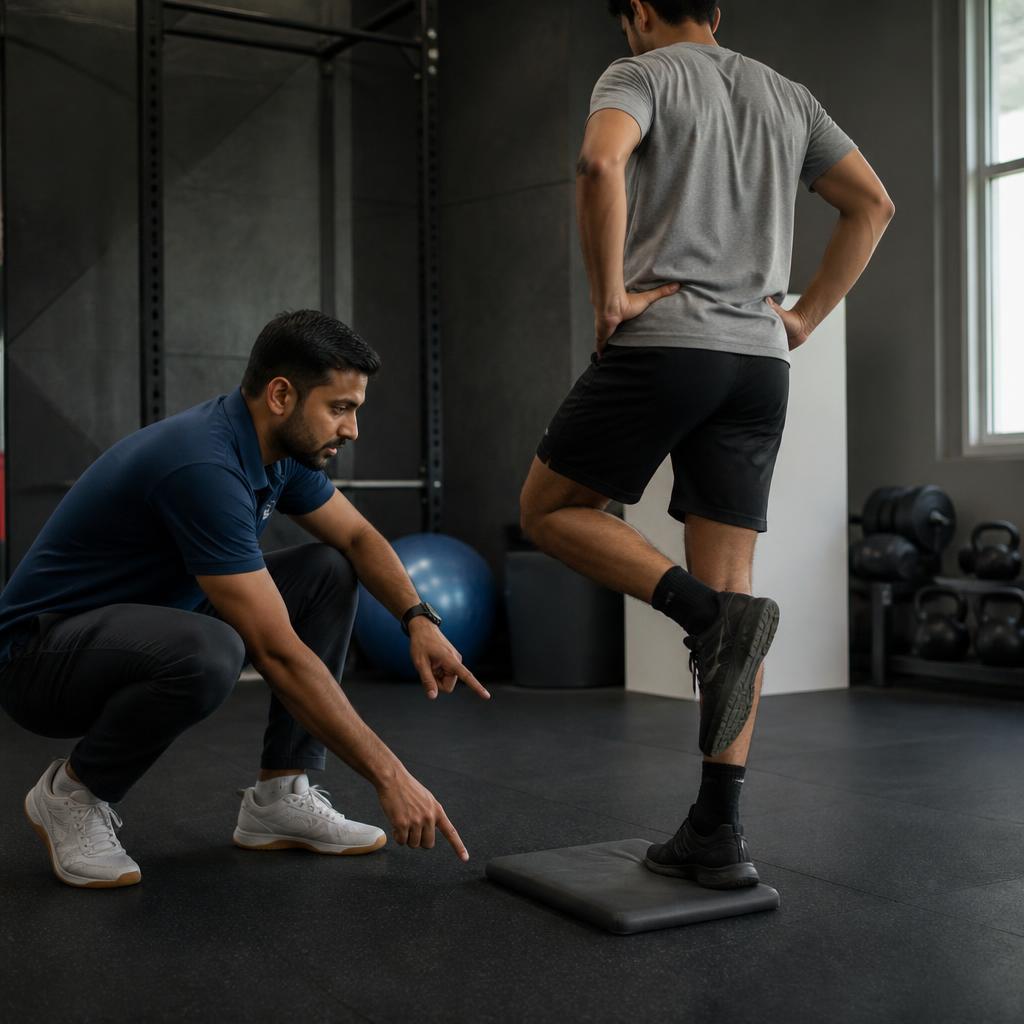
The physiotherapist checks swelling response, extension and flexion, quadriceps and hamstring strength, hip control, calf capacity, single-leg balance, landing strategy, and the person’s reaction to changes in load. Hop testing is not an early test and is not appropriate when pain, swelling, poor control, or a surgeon’s restriction remains.
How rehabilitation can progress
Early work protects the knee while restoring movement and a confident walking pattern. Strength then progresses from controlled closed-chain tasks to single-leg strength, deceleration, landing, and change-of-direction preparation. Running usually starts with a low-volume, predictable surface and rest days. Distance, speed, hills, and sport drills should not all increase together.
What to expect from a home physiotherapy session
The therapist observes stairs, a sit-to-stand, a single-leg task when safe, and the person’s home exercise technique. They may use video feedback for landing control, prescribe a simple strength circuit, and agree on a running log. The next-day response matters: swelling, loss of extension, or a clear limp is information that the dose needs review.
Do
- Follow the surgeon’s loading restrictions, build strength consistently, warm up before running, and progress one training variable at a time while tracking next-day swelling.
- Keep a simple record of symptoms, activity, sleep, and the tasks that are becoming easier or harder.
- Share medical reports, medication changes, surgeon restrictions, and any recent change in symptoms before exercise is progressed.
Don’t
- Do not use the ability to walk as proof that cutting, jumping, or a full match is safe, and do not return to running through repeated swelling or giving-way episodes.
- Do not copy an exercise from a video if it increases symptoms, requires equipment you cannot control, or conflicts with a medical restriction.
- Do not use pain, fatigue, or a single good day as the only measure of readiness for a harder task.
Safety and when to seek medical advice
Urgent review is needed for a locked knee, inability to bear weight after a new twist, a rapidly swollen calf, chest pain, shortness of breath, or a new fall. A knee that repeatedly gives way or loses movement should be discussed with the orthopaedic and rehabilitation teams.
Booking and follow-up
Home physiotherapy is arranged after the team understands the person’s condition, location, current precautions, and preferred care. Goswami Rehab offers home visits at ₹1,125–₹1,350 and online consultation at ₹742. Send the online booking request with the main concern, city, and preferred dates; the team confirms the appropriate next step within 24 hours. A teleconsultation can be useful when travel is difficult or when an exercise plan needs review, but it does not replace emergency or specialist medical care.
The article is educational information only. It does not diagnose a condition or replace advice from a doctor, surgeon, obstetrician, cancer team, or treating physiotherapist. Individual plans, timelines, and outcomes vary.
Clinical sources & further reading
These public resources provide general clinical guidance. They do not replace an assessment or an individual treatment plan.
- Anterior cruciate ligament injuryNHS
- Physical Activity BasicsCenters for Disease Control and Prevention
- PhysiotherapyNHS
- Gurugram District: official district informationDistrict Administration, Gurugram
- RehabilitationMedlinePlus, U.S. National Library of Medicine
- Orthopedic conditionsNational Institute of Arthritis and Musculoskeletal and Skin Diseases
Continue exploring
Choose your next step
Keep exploring with a focused guide, a relevant care option, or a direct enquiry.
Need professional advice?
Book an assessment with our expert team.