At a glance
What this guide can help you understand
Rotator cuff surgery is followed by months of staged physiotherapy. This guide explains the usual rehabilitation phases, protection of the repair, and questions to discuss with your surgeon and physiotherapist.
What should you bring to a consultation?
Share your main concern, when it started, what affects it, current medicines, and any reports or precautions you have been given.
See our clinical assessment approachWhen should you pause and seek medical advice?
Pause routine exercise and seek medical advice for sudden severe change, new neurological symptoms, breathing difficulty, chest pain, major injury, or feeling acutely unwell.
This guide is educational and does not replace diagnosis or urgent care.
The rotator cuff is a group of four muscles and their tendons that surround the shoulder joint, providing stability and enabling the wide range of arm movement the shoulder is capable of. When one or more of these tendons tear — through injury or degeneration — surgery may be required to reattach them.
Rotator cuff repair is an anchor-based procedure that reattaches the torn tendon to the bone. The biology of tendon-to-bone healing is slow: it takes approximately 12 weeks for the repaired tissue to develop meaningful strength. The entire rehabilitation process spans 6–12 months depending on tear size and patient factors.
This is not a quick recovery. Physiotherapy aims to support safe movement and function, but the outcome depends on the tear, repair, healing, symptoms, and the wider rehabilitation plan.
Why Homecare Physiotherapy Suits Shoulder Rehab
Shoulder rehabilitation requires precise, pain-free movement in multiple planes — activities that map directly onto daily life tasks. Reaching for a glass, getting dressed, washing hair — these are the functional targets. Homecare physiotherapy works on exactly these tasks in exactly the environment where they occur.
Phase 1 — Passive Range of Motion (Weeks 1–6)
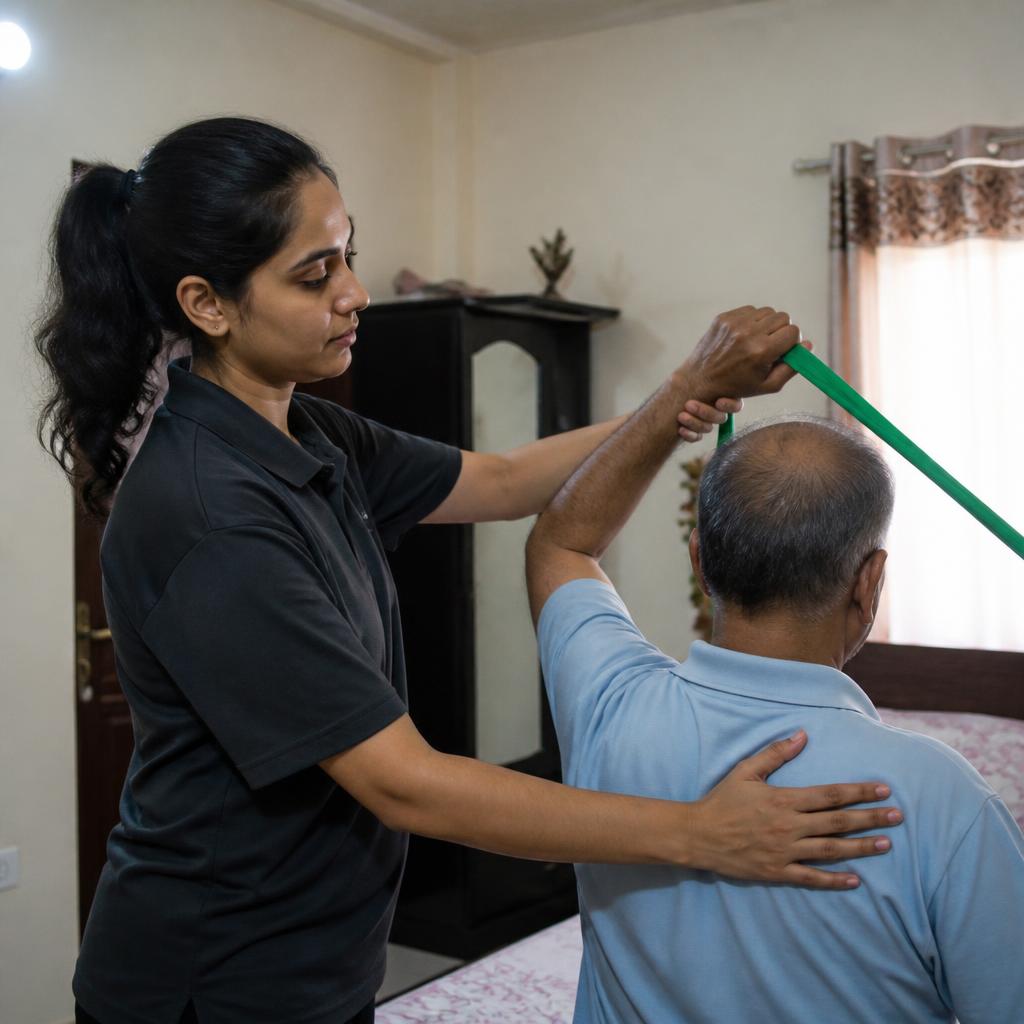
The repaired tendon must be protected while it heals. During this phase, the arm may be kept in a sling and the physiotherapist may perform passive movements — moving the arm through range without muscle contraction from the patient — according to the surgeon's protocol. This can support movement without placing unnecessary load on the healing repair.
Key points:
- The sling is worn at all times except during exercises and hygiene
- No active use of the operated arm
- Pendulum exercises in gravity-eliminated positions are introduced early
- Elbow, wrist, and hand exercises maintain circulation and prevent stiffness below the repair
Phase 2 — Active-Assisted and Active Range of Motion (Weeks 6–12)
As the repair gains biological strength, the patient begins to actively assist movement with the operated arm. Movements progress gradually from gravity-eliminated to gravity-resisted positions.
Goals:
- Achieve forward flexion and abduction to 90 degrees by week 8–10
- Begin gentle isometric strengthening (muscle contraction without joint movement)
- Progress to active overhead reaching by weeks 10–12
Phase 3 — Strengthening (Months 3–6)
The focus shifts to rebuilding the strength and endurance of the rotator cuff and the shoulder stabilisers (particularly the lower trapezius and serratus anterior). Light resistance training progresses to moderate resistance as tissue strength develops.
Common exercises:
- External rotation with resistance band
- Prone Y, T, and W exercises for scapular control
- Progressive pushing and pulling patterns
Phase 4 — Return to Full Function (Months 6–12)
For patients who use their arms for sport, heavy work, or overhead activities, the final phase involves sports-specific loading, power development, and return-to-activity testing. Full clearance for overhead sport typically occurs at 9–12 months for large tears.
Protecting the Repair
The most important principle throughout rehabilitation: never push through sharp or catching pain in the shoulder. Discomfort from the surrounding muscles working hard is normal. Pain at the repair site is a warning signal. Our physiotherapists teach patients to distinguish between the two.
Goswami Rehab delivers post-rotator cuff repair homecare programs with structured progression, regular reassessment, and close coordination with your orthopaedic surgeon throughout your recovery.
Clinical sources & further reading
These public resources provide general clinical guidance. They do not replace an assessment or an individual treatment plan.
Continue exploring
Choose your next step
Keep exploring with a focused guide, a relevant care option, or a direct enquiry.
Need professional advice?
Book an assessment with our expert team.