At a glance
What this guide can help you understand
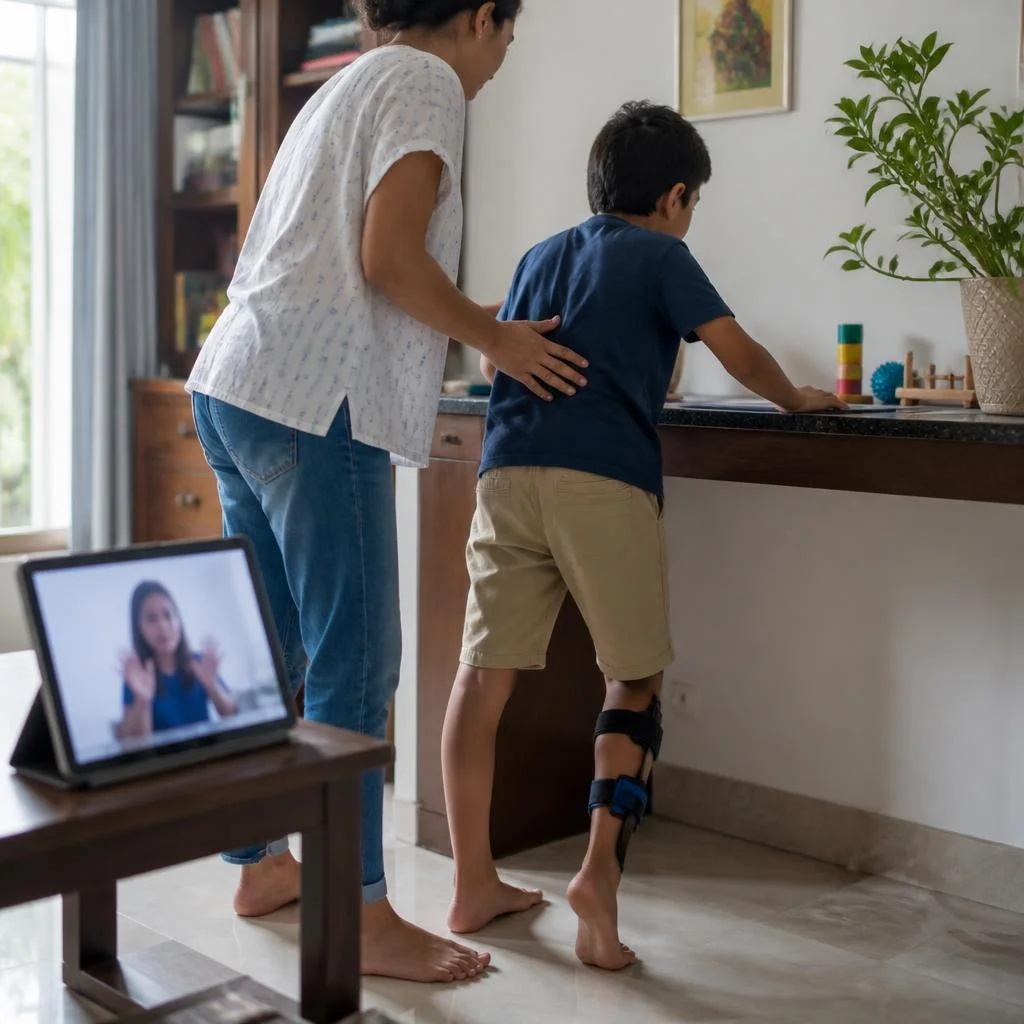
For a family supporting a child with cerebral palsy (CP), a useful physiotherapy session is one that fits the child’s goals and everyday life. Online appointments can make it easier to discuss routines and practise a task in the place where it happens. But a video call is a way to deliver some parts of care—not a diagnosis, a promise of improvement, or a substitute for every hands-on assessment.
What should you bring to a consultation?
Share your main concern, when it started, what affects it, current medicines, and any reports or precautions you have been given.
See our clinical assessment approachWhen should you pause and seek medical advice?
Pause routine exercise and seek medical advice for sudden severe change, new neurological symptoms, breathing difficulty, chest pain, major injury, or feeling acutely unwell.
This guide is educational and does not replace diagnosis or urgent care.
For a family supporting a child with cerebral palsy (CP), a useful physiotherapy session is one that fits the child’s goals and everyday life. Online appointments can make it easier to discuss routines and practise a task in the place where it happens. But a video call is a way to deliver some parts of care—not a diagnosis, a promise of improvement, or a substitute for every hands-on assessment.
What the newer evidence says
The research is encouraging in places, but it is not uniform. A September 2026 systematic review included eight randomized trials involving 419 children with CP. Its pooled estimate suggested improvement in gross motor function, but the estimate was very uncertain: studies differed greatly from one another (I²=96%), and the evidence was rated low certainty. The fine-motor estimate did not rule out no effect (SMD 0.62; 95% CI −0.25 to 1.49; I²=90%). These figures describe groups in varied studies; they cannot predict what will happen for one child. 1
A separate 2026 review focused on home-based, remotely monitored therapy for children and adolescents with unilateral CP. It included nine studies (ten reports; 481 participants), but rated the evidence low certainty because of risk of bias and imprecision. Several studies were small, and safety reporting was inconsistent. 2
One August 2026 comparison of synchronous video sessions with clinic sessions reported improvement in both groups and no statistical superiority of either delivery mode. Caregiver satisfaction was higher in the face-to-face group. The accessible abstract does not report a sample size, so it should not be described as a large or definitive trial. 3
Earlier studies help explain why delivery format alone is not the whole story. A 2023 trial of 43 preschool children tested a supported 12-week home programme that combined weekly video contact with substantial daily practice; it compared that package with usual care, not equal-dose online and in-person therapy. A 2025 Bangladesh trial of 968 children tested a broader service model—referral links, local centres, peer support and telerehabilitation. It improved access to rehabilitation, but did not show a significant difference in clinical outcomes. Neither result proves that video by itself caused the change. 4 5
Taken together, these findings support a careful conclusion: remote coaching can be useful for some goals and families, especially when it is structured and connected to an ongoing care plan. Current evidence does not establish that online care is better than, or interchangeable with, well-matched in-person care. Earlier reviews and small delivery trials also describe varied programmes and outcomes, rather than one standard “CP teletherapy” treatment. 6 7 8
What a video appointment can help with
When a child is medically stable and a physiotherapist has agreed that remote follow-up is appropriate, a call can help the family and therapist:
- choose a practical goal, such as taking part in dressing, play, transfers or a familiar daily routine;
- see how the task and home environment work in real life, rather than relying only on a clinic description;
- coach a parent or caregiver through a previously agreed activity and adjust the setup;
- review what made practice easier or harder, including fatigue, timing, space and equipment;
- keep contact between in-person visits, or reduce travel when access is difficult.
The child should be included in decisions in a way that suits their age and communication. A parent’s role is to support the activity, not to become the therapist or push through pain, distress or unusual fatigue. Family-centred planning and individualized caregiver training are consistent with clinical guidance; the goals should be agreed with the family and reviewed as the child’s needs change. 9 10 11
In India, physiotherapists have reported using telerehabilitation during the pandemic, but a survey of professionals’ experiences and willingness is not evidence that a particular online programme improves a child’s function. It can help explain access barriers and attitudes; it should not be presented as a clinical effectiveness trial. 12 13
When remote care should not be the only step
A therapist may need to examine the child in person, arrange a home visit, or coordinate with another clinician when a question depends on hands-on assessment or specialist equipment. Examples include a new or worsening pain, repeated falls, a substantial change in movement, a concern about a brace or wheelchair fit, or a transfer that does not look safe on camera. New concerns about choking, swallowing or recurrent chest infections need assessment by the appropriate medical or speech-and-language team; a physiotherapy video call is not a swallowing assessment. Clinical guidance describes multidisciplinary assessment and review for these concerns, without requiring every routine interaction to happen face-to-face. 9
Remote sessions also have practical limits: camera angles can hide movement, connectivity can fail, and the therapist cannot physically support a child if balance is lost. If the planned task cannot be done safely with the available caregiver and equipment, stop and ask the therapist for another plan rather than improvising.
How to prepare for a useful session
Before the call, agree on the goal and ask what space or equipment will be needed. Place the camera so the therapist can see the relevant movement, clear the area, and have a caregiver nearby if the therapist requests it. Let the child know what will happen and pause if they become distressed, unwell or unusually tired. Do not start a new exercise, force a movement, or change a brace or device based only on a general online article.
A blended plan may work best: an in-person assessment when needed, home practice chosen around the child’s routine, and remote check-ins to review progress. The right mix depends on the child, family, goals, safety and access—not on a rule that one format is always superior.
For more on how the two service formats differ, see our guides to online physiotherapy in India and physiotherapy at home.
Bottom line: online physiotherapy can support coaching, goal review and home routines for some children with CP. It should sit inside an individualized care plan, with in-person or specialist assessment when the clinical question requires it.
Local coverage: Browse all 44 city pages for home physiotherapy.
Clinical sources & further reading
These public resources provide general clinical guidance. They do not replace an assessment or an individual treatment plan.
- Home-based telerehabilitation on motor function in youth with cerebral palsy: systematic review and meta-analysisnature.com
- Effects of telerehabilitation-monitored home-based therapies on upper extremity function-related outcomes in children and adolescents with unilateral cerebral palsy: A systematic reviewjournals.sagepub.com
- Comparison of Synchronous Telerehabilitation and Face-to-Face Methods on Upper Extremity Function in Children with Hemiparetic Cerebral Palsypubmed.ncbi.nlm.nih.gov
- Effects of Telerehabilitation-Based Structured Home Program on Activity, Participation and Goal Achievement in Preschool Children with Cerebral Palsy: A Triple-Blinded Randomized Controlled Trial.mdpi.com
- Sustainable Model of Early Intervention and Telerehabilitation for Children With Cerebral Palsy in Rural Bangladesh: The SMART-CP Randomized Clinical Trial.pubmed.ncbi.nlm.nih.gov
- Effects of Telerehabilitation on Gross Motor Function in Children with Cerebral Palsy: A Systematic Review.pmc.ncbi.nlm.nih.gov
- Telerehabilitation and Face-to-Face Exergame Delivery Modalities to Improve Postural Control in Children with Cerebral Palsy: A Randomised Controlled Trial.pmc.ncbi.nlm.nih.gov
- Telehealth and Remote Interventions for Children With Cerebral Palsy: Scoping Review.pmc.ncbi.nlm.nih.gov
- Recommendations | Cerebral palsy in under 25s: assessment and management (NG62).nice.org.uk
- The processes and outcomes related to ‘family-centred care’ in neuromotor and functional rehabilitation contexts for children with cerebral palsy: A scoping review.pubmed.ncbi.nlm.nih.gov
- Group-based caregiver support interventions for children living with disabilities in low-and-middle-income countries: Narrative review and analysis of content, outcomes, and implementation factors.pmc.ncbi.nlm.nih.gov
- Perceptions and Willingness of Physiotherapists in India to Use Telerehabilitation During the COVID-19 Pandemicpmc.ncbi.nlm.nih.gov
- Treatment and re/habilitation of children with cerebral palsy in India: a scoping reviewpubmed.ncbi.nlm.nih.gov
Continue exploring
Choose your next step
Keep exploring with a focused guide, a relevant care option, or a direct enquiry.
Need professional advice?
Book an assessment with our expert team.