At a glance
What this guide can help you understand
An online physiotherapy consultation can make it easier to discuss symptoms and observe movement without travelling. But a camera cannot reproduce every part of an in-person examination. The right format depends on what the physiotherapist needs to learn, whether the camera can show it clearly, and whether you can participate safely.
What should you bring to a consultation?
Share your main concern, when it started, what affects it, current medicines, and any reports or precautions you have been given.
See our clinical assessment approachWhen should you pause and seek medical advice?
Pause routine exercise and seek medical advice for sudden severe change, new neurological symptoms, breathing difficulty, chest pain, major injury, or feeling acutely unwell.
This guide is educational and does not replace diagnosis or urgent care.
An online physiotherapy consultation can make it easier to discuss symptoms and observe movement without travelling. But a camera cannot reproduce every part of an in-person examination. The right format depends on what the physiotherapist needs to learn, whether the camera can show it clearly, and whether you can participate safely.
What video can help a physiotherapist assess
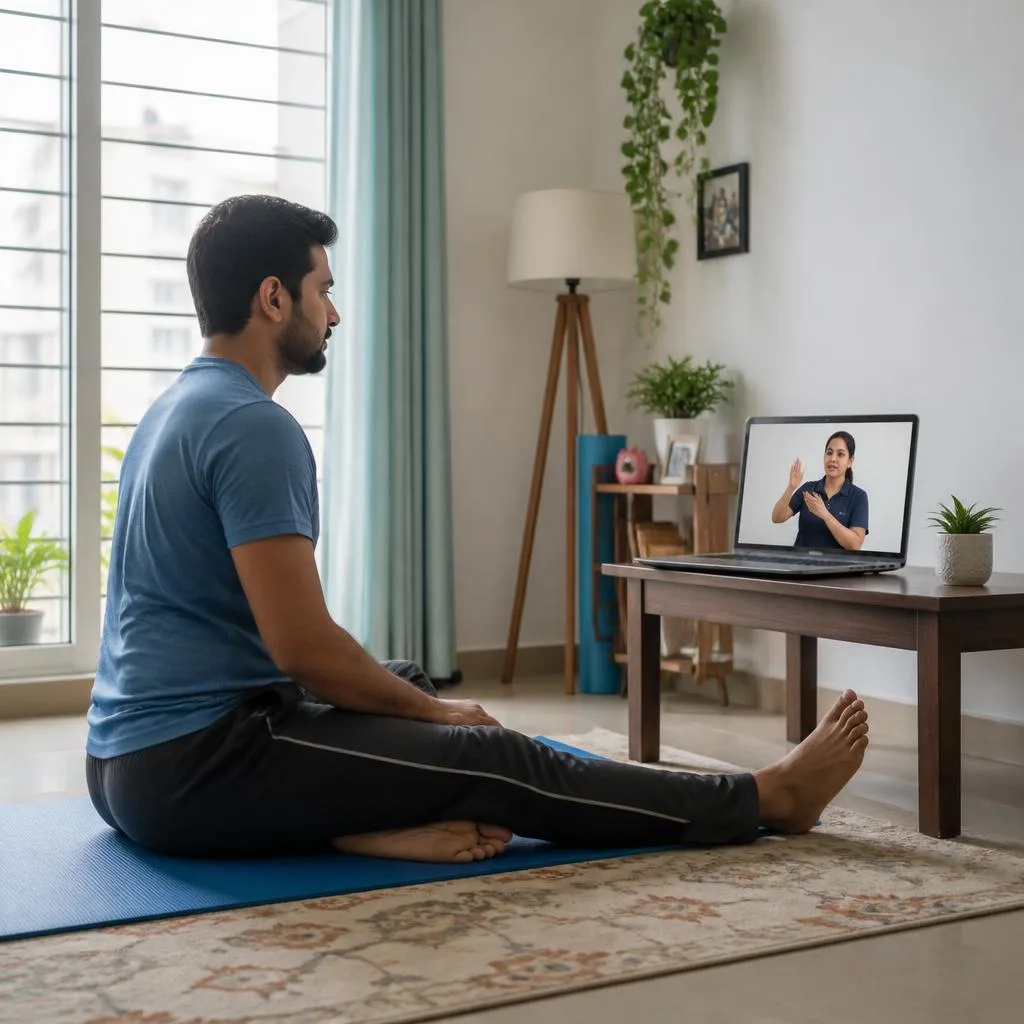
A video visit can support a detailed conversation about when a problem began, what changes it, how it affects sleep or daily tasks, and what you hope to do again. With adequate lighting, space, and camera placement, the physiotherapist may also observe active movement, a simple functional task, balance or walking, and how you perform an exercise that has already been judged suitable.
Some research supports specific video-based assessment measures—not a complete remote physical examination. A systematic review of ten repeated-measures studies involving 193 adults found different levels of agreement across clinical tests, movement measures, pain, and patient-reported outcomes. Evidence certainty ranged from very low to high; spinal-posture observations were a notable limitation. The findings do not mean that every test, diagnosis, or person can be assessed equally well over video. [1]
What video may not settle
A screen cannot provide touch, palpation, or the same hands-on testing used to assess some kinds of swelling, tissue tenderness, joint movement, strength, reflexes, or sensation. A small camera view can also hide a foot, a support surface, or a nearby obstacle. The clinician may need to change the plan if the picture is unclear, a movement cannot be performed safely, or an important question remains unanswered.
This is not a failure of online care. A safe consultation includes recognising when the available information is not enough and arranging another kind of assessment.
What the evidence says—and does not say
| Evidence | What was studied | Useful finding | Important limit |
|---|---|---|---|
| Systematic review, 10 studies and 193 adults [1] | Digital compared with face-to-face musculoskeletal physiotherapy assessment | Several specific measures had acceptable-to-excellent validity or reliability; certainty varied by measure. | Does not validate every test or a whole examination; spinal-posture observation performed poorly in the review. |
| Systematic review of patient and clinician experiences [2] | Ten articles selected from 394 records, published 2019–2024 | Access, flexibility, and reduced travel were reported alongside concerns about less physical contact, technology, privacy, and clinical reasoning. | Heterogeneous studies and sampling limitations mean the themes are not universal. |
| REFORM randomized trial, 210 adults [3] | Six-week remote-care package versus usual outpatient physiotherapy in Sydney | The remote group met the study’s non-inferiority criterion for function at six weeks. | Remote care began with an in-person assessment and included an app, messages, and calls. It was not video-only, was not an Indian study, and did not establish superiority or RA-specific outcomes. |
The REFORM result is a useful example of why the delivery model matters. Its remote arm combined an in-person assessment with app-based exercises, weekly messages, and follow-up calls. The adjusted difference on the Patient-Specific Functional Scale was 2.7 points (95% confidence interval −3.5 to 8.8), within the trial’s pre-set −15-point non-inferiority margin. In plain language, the trial did not find this particular remote package unacceptably worse than usual care under its chosen limit; because the interval crossed zero, it did not show that remote care was better. [3]
Professional guidance can help clinicians plan and prepare for tele-rehabilitation, but it does not create a universal rule that video is suitable for everyone. The APTA guideline summary covers implementation, potential benefits, harms, and costs; a US government preparation guide discusses connection checks, visit expectations, equipment, and caregiver availability. These sources are practical references, not Indian legal requirements. [4][5]
When a home visit may be more useful
A home visit may be worth discussing when the question is about a real task in your own space: getting up from your usual chair, using stairs, reaching into a cupboard, moving between the bed and bathroom, or using a walking aid along a familiar route. Seeing the actual room and task can help the physiotherapist understand barriers that a small video frame may miss.
In-person assessment may also be more appropriate when hands-on examination or physical assistance is needed, when a movement cannot be supervised safely by video, or when the clinician cannot answer an important question remotely. A home visit is not automatically safer or more effective; the clinician should explain why that format fits the assessment. If a problem may need urgent medical attention, seek the appropriate medical service rather than waiting for a routine physiotherapy appointment.
Illustrative scenario—not a testimonial: Someone with difficulty rising from a low chair joins a video consultation. The physiotherapist can discuss symptoms and observe a carefully chosen movement if it is safe. If the next question is how the person manages their own narrow hallway, stairs, or bathroom transfer—or if close physical support is needed—a home assessment may provide more useful information.
How to prepare for a video consultation
- Choose a private, well-lit space with enough room to show the movement being discussed.
- Keep a stable phone or laptop on a secure surface; do not balance it on furniture that may move.
- Have a sturdy chair or other support nearby, and do not attempt a movement that feels unsafe.
- Share relevant reports or a medication list if the clinician asks, and describe your main daily goal.
- Ask what to do if the connection drops, who can see the video or records, and how the clinician will decide whether an in-person visit is needed.
A note about India
India’s 2020 Telemedicine Practice Guidelines are expressly framed for Registered Medical Practitioners under the medical-register framework. That document does not, by itself, settle what rules apply to physiotherapists, whether a particular online service is appropriate, or what other professional requirements may apply. Check the provider’s qualifications and ask which current professional standards govern the service. This article is educational, not legal advice. [6]
If you are unsure which format to choose, ask the physiotherapist what they can assess by video, what would trigger a change of plan, and whether a home visit or clinic examination would answer the question better. You can also read the site’s guides to online physiotherapy, home physiotherapy versus clinic physiotherapy, and your first physiotherapy assessment.
Educational notice: This article is general information, not an individual diagnosis, emergency service, or exercise prescription. A clinician should decide whether a remote assessment is suitable for your situation.
Local coverage: Browse all 44 city pages for home physiotherapy.
Clinical sources & further reading
These public resources provide general clinical guidance. They do not replace an assessment or an individual treatment plan.
- Digital physiotherapy assessment vs conventional face-to-face physiotherapy assessment of patients with musculoskeletal disorders: A systematic reviewjournals.plos.org
- Patient and clinician perceptions of telehealth in musculoskeletal physiotherapy services - A systematic review of the evidence-basejournals.plos.org
- Remotely delivered physiotherapy is as effective as face-to-face physiotherapy for musculoskeletal conditions (REFORM): a randomised trialsciencedirect.com
- Telerehabilitation in Physical Therapist Practice: A Clinical Practice Guideline From the American Physical Therapy Associationapta.org
- Preparing patients for tele-physical therapytelehealth.hhs.gov
- Telemedicine Practice Guidelinesesanjeevani.mohfw.gov.in
Continue exploring
Choose your next step
Keep exploring with a focused guide, a relevant care option, or a direct enquiry.
Need professional advice?
Book an assessment with our expert team.